A heartbreaking case in Florida has drawn national attention after Governor Ron DeSantis called on state lawmakers to consider impeaching a judge whose decision is now being scrutinized in the wake of a young child’s death.
The situation has stirred strong emotions across the public sphere, not only because of the tragedy itself, but also due to the complex legal and ethical questions it raises. At the center of the debate lies a difficult issue: where does individual responsibility end, and where do systemic shortcomings begin?
A Tragedy That Raised Difficult Questions
According to publicly available reports, the case involves a man who had previously been convicted in a serious criminal matter involving inappropriate conduct toward a minor. Following his conviction, the court allowed him to remain out of custody while awaiting sentencing.
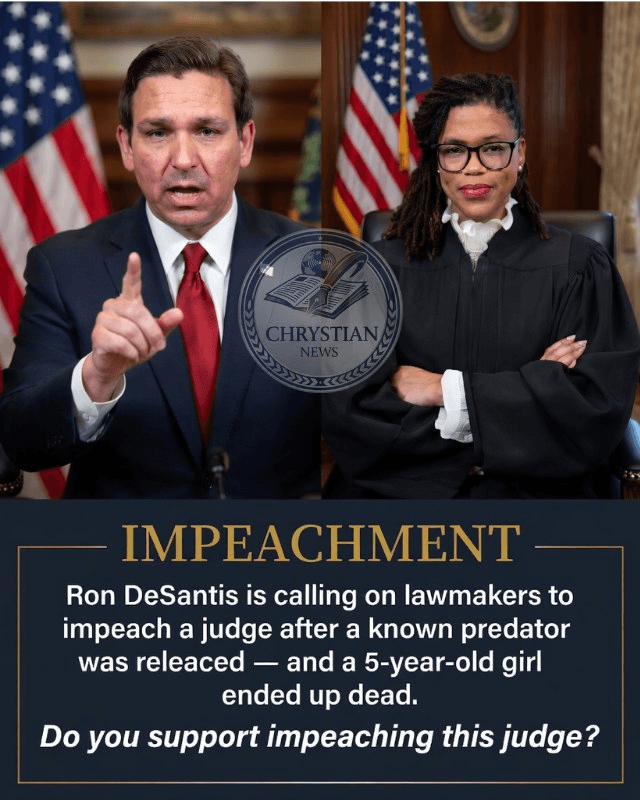
That decision, made by a circuit court judge, has since come under intense scrutiny.
During the period in which he remained free, the man was later accused of committing a far more severe crime—the death of a 5-year-old girl, identified as his child. The details surrounding the incident shocked the local community and quickly spread across national media, prompting widespread grief and anger.
While the legal process leading up to the suspect’s release followed existing procedures at the time, the tragic outcome has led many to question whether those procedures were sufficient to protect vulnerable individuals.
Legislative Response: The Emergence of “Missy’s Law”
In response to the public outcry, Florida officials moved quickly to introduce and pass new legislation aimed at preventing similar situations in the future.
The law, informally referred to as “Missy’s Law,” seeks to tighten rules around post-conviction release. Under this new framework, individuals convicted of certain serious offenses—particularly those involving harm or risk to children—may be required to remain in custody while awaiting sentencing, rather than being granted release.
Supporters of the law argue that it addresses a critical gap in the system, one that may have contributed to the events leading up to this tragedy. By limiting judicial discretion in high-risk cases, lawmakers hope to reduce the likelihood of similar incidents occurring again.
However, as with many legal reforms enacted in response to specific events, questions remain about how broadly such measures should be applied and what unintended consequences they might bring.
The Call for Impeachment
Alongside the legislative changes, Governor Ron DeSantis publicly called for lawmakers to consider impeaching the judge involved in the case. The move represents a significant escalation, as impeachment of a sitting judge is both rare and procedurally complex.
State officials, including the Attorney General, have argued that the decision to allow the defendant to remain free demonstrated a serious lapse in judgment. From their perspective, the consequences of that decision warrant a formal review of the judge’s conduct.
At the same time, others caution that focusing solely on one individual risks oversimplifying a much more complex issue. Judicial decisions are often made based on the laws and guidelines in place at the time, as well as the information available during the proceedings.
This raises an important question: should a judge be held personally accountable for a decision that, while controversial in hindsight, may have been legally permissible?
Judicial Discretion and Its Limits
At the heart of the debate is the concept of judicial discretion—a fundamental principle in the American legal system.
Judges are often required to make decisions that involve balancing multiple factors, including public safety, the rights of the accused, and recommendations from prosecutors and defense attorneys. In cases involving post-conviction release, these decisions can be particularly challenging.
Factors that may influence such rulings include:
- The nature and severity of the offense
- The defendant’s criminal history
- The likelihood of reoffending
- The risk of flight
- Input from legal counsel on both sides
In this case, the judge’s decision to allow release fell within the scope of existing legal authority at the time. However, the tragic outcome has led many to question whether those legal standards were sufficient—or whether they placed too much responsibility on individual judgment.
A Systemic Issue or an Individual Failure?
Legal experts and observers have offered differing perspectives on how to interpret the events.
Some argue that the case highlights systemic weaknesses rather than individual wrongdoing. Prior to the passage of “Missy’s Law,” Florida law provided judges with considerable flexibility in determining whether a convicted individual should remain in custody before sentencing.
From this viewpoint, the judge’s decision may not have been unusual within the broader legal framework. Instead, the tragedy underscores the need for clearer, more consistent guidelines.
Others, however, believe that even within a flexible system, certain decisions carry heightened responsibility—particularly when they involve individuals previously convicted of offenses against minors.
The tension between these perspectives reflects a broader challenge in legal systems worldwide: how to design rules that are both flexible enough to allow fair judgment and strict enough to protect public safety.
Public Reaction and Social Impact
The case has generated significant public reaction, especially on social media platforms, where emotional responses have been widespread.
Many individuals have expressed anger and frustration, calling for greater accountability within the justice system. For them, the sequence of events appears to represent a preventable failure.
At the same time, there are voices urging caution against drawing conclusions too quickly. These perspectives emphasize the importance of due process and warn against allowing outcomes—however tragic—to dictate judgments about legal decisions made under different circumstances.
This divide in public opinion highlights the emotional weight of the case, as well as the difficulty of discussing it in purely legal terms.
The Complexity of Impeachment Proceedings
Impeaching a judge is a serious and relatively rare action. In Florida, the process involves multiple steps and requires approval from the state legislature.
Typically, the state’s House of Representatives would first need to bring formal charges. If those charges are approved, the case would then proceed to the Senate for a trial.
Such proceedings often involve detailed investigations, testimony, and legal analysis. They are not undertaken lightly, and outcomes can vary widely depending on the specifics of each case.
Given the complexity of the process, it remains uncertain whether the call for impeachment will ultimately result in formal action.
Broader Questions Moving Forward
Beyond the immediate legal and political implications, the case raises several broader questions that may shape future discussions:
- Should laws limit judicial discretion more strictly in high-risk cases?
- How can legal systems better balance individual rights with community safety?
- What mechanisms should exist to review decisions that lead to unintended consequences?
These questions do not have simple answers, but they are likely to remain central to ongoing debates in Florida and beyond.
Conclusion: A Tragedy That Resonates Beyond the Courtroom
The loss of a young life has left a profound impact on a community and sparked a wider conversation about justice, responsibility, and reform.
While legislative changes such as “Missy’s Law” aim to address gaps in the system, the debate over accountability—particularly in relation to judicial decisions—continues to unfold.
Ultimately, the case serves as a reminder of the complexities inherent in any legal system. It also underscores the importance of continuous evaluation and improvement, especially when the stakes involve public safety and human life.
As discussions move forward, the focus may shift from assigning blame to understanding how systems can evolve to prevent similar tragedies in the future.