In September 1996, bluegrass music came home to say goodbye.
Not to a hit song.
Not to a famous performance.
But to the man many considered the foundation of an entire genre.
Bill Monroe was gone.
He was 84 years old.
And after spending more than six decades shaping the sound of bluegrass music, he returned to the Ryman Auditorium one final time.
The crowds began arriving early.
Musicians.
Friends.
Fans.
People whose lives had been touched by Monroe’s music in one way or another.
More than 2,000 individuals filed past his casket to pay their respects.
For many, it felt like the end of an era.
The Small Details People Remembered
Inside the room sat reminders of the man beyond the legend.
A white cowboy hat rested nearby.
So did something unexpected.
A roll of quarters.
Those who knew Bill Monroe understood exactly why it was there.
He had a habit of quietly slipping coins to children when nobody was paying attention.
It wasn’t a grand gesture.
It wasn’t done for publicity.
It was simply part of who he was.
Moments like that stayed with people long after the music ended.
The Music Had To Be There
A farewell for Bill Monroe could never be silent.
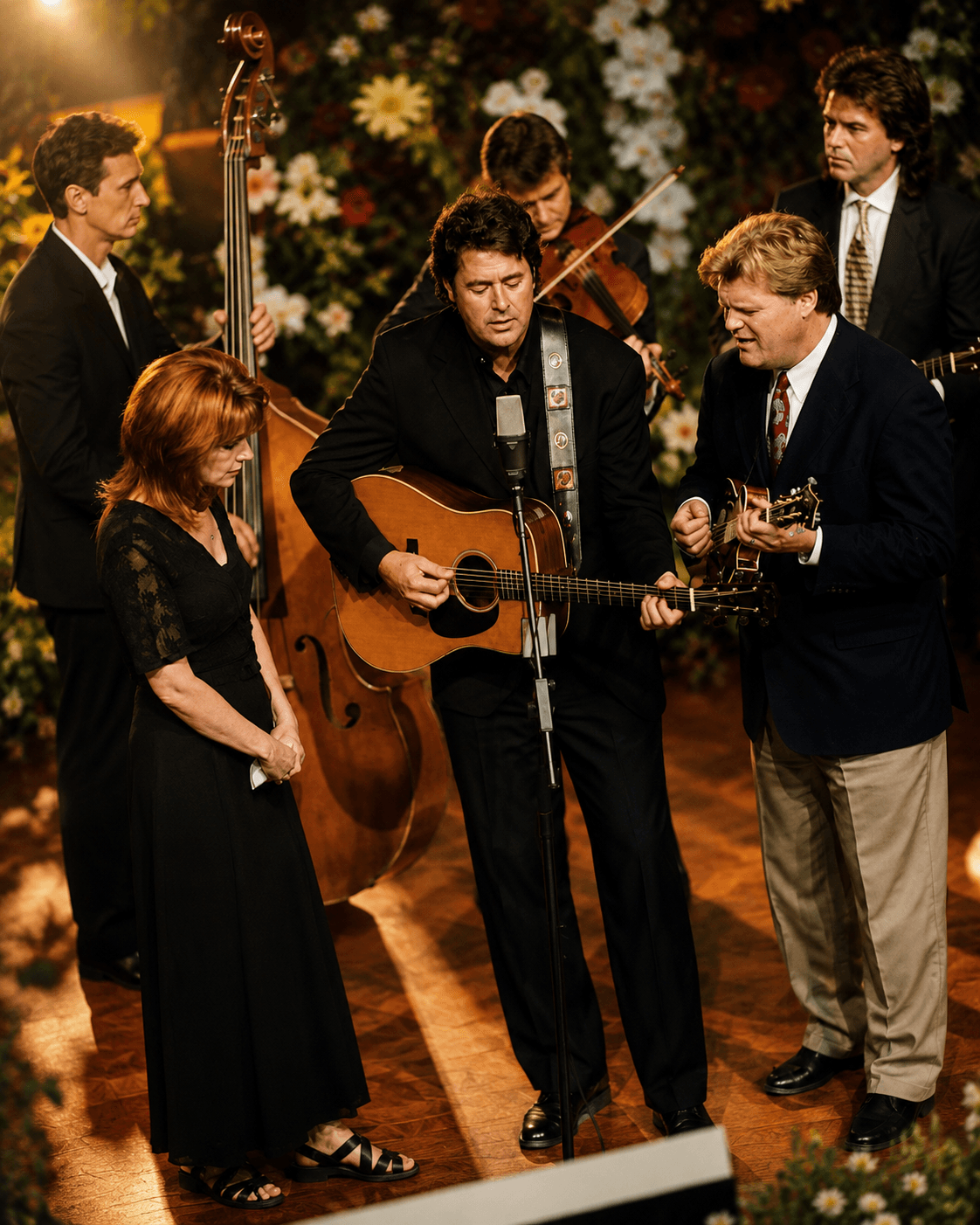
Soon, some of country and bluegrass music’s most respected voices stepped onto the stage.
Patty Loveless.
Vince Gill.
Ricky Skaggs.
Marty Stuart.
Each came carrying memories of a man whose influence stretched across generations.
They sang.
They smiled.
They fought back tears.
And for brief moments, the grief inside the room seemed lighter.
The way Monroe himself might have preferred.
The Moment That Stayed With Marty Stuart
For some artists, the memorial was more than a goodbye.
It became a turning point.
Ricky Skaggs felt it.
Marty Stuart felt it even more deeply.
Standing in that room, surrounded by the music, the history, and the people whose lives had been shaped by Bill Monroe, something shifted.
The experience forced a question many artists eventually face.
What matters most?
Chart positions?
Radio success?
Or leaving behind something that lasts longer?
A Different Path Forward
Not long after Monroe’s passing, Marty Stuart began rethinking the direction of his own career.
The pursuit of commercial success no longer felt like the only goal.
What mattered was authenticity.
History.
Preservation.
The traditions that had inspired him from the beginning.
Over time, he moved further toward the music that meant the most to him personally.
Later, Stuart would describe it as the only choice he could make.
The experience at Monroe’s memorial had simply clarified what he already knew in his heart.
The Legacy Bill Monroe Left Behind
Many artists leave behind great songs.
Some leave behind great careers.
Bill Monroe left behind something larger.
An entire musical tradition.
Generations of musicians.
Countless recordings.
And a style of music that continues to influence artists decades after his passing.
That is why more than 2,000 people came to the Ryman.
They weren’t only honoring a performer.
They were honoring a foundation.
And perhaps the most powerful tribute came not from the flowers, the speeches, or the tears.
It came from the artists who walked out of that room determined to carry the music forward.
Exactly the way Bill Monroe had spent sixty years teaching them to do.