The internet loves a mystery.
It loves a rebellion.
And it loves filling in blanks before facts arrive.
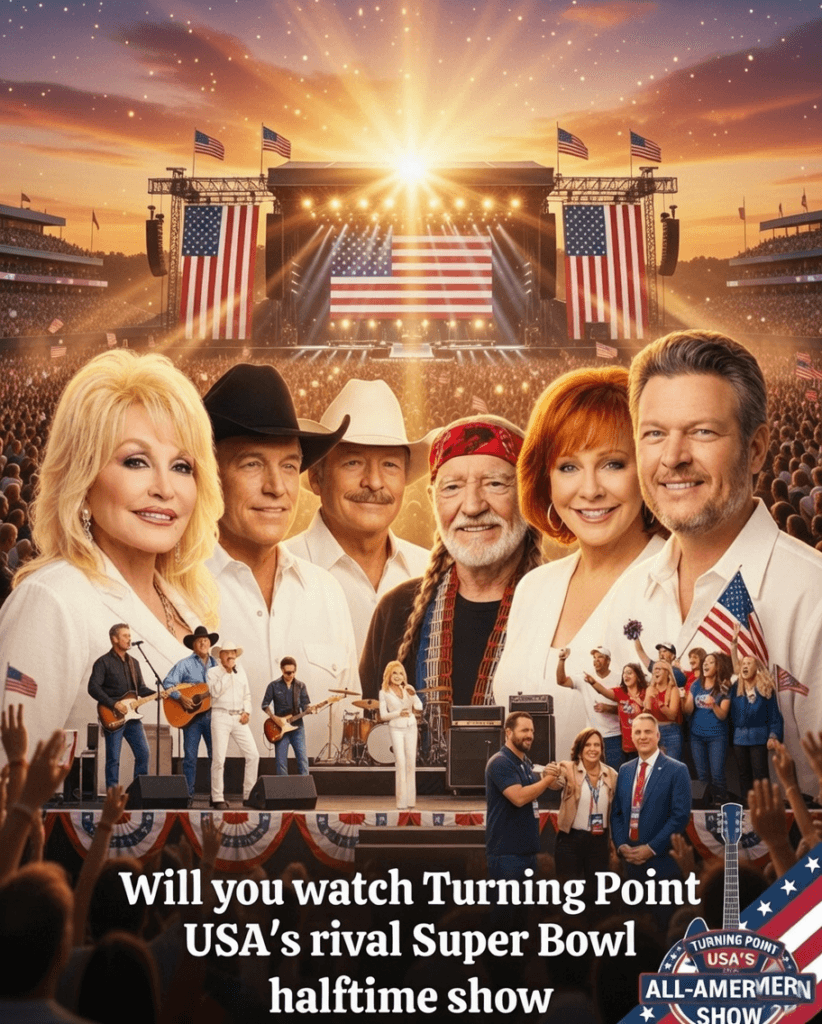
That’s exactly what’s happening right now around a proposed All-American–themed halftime concept that has suddenly taken over timelines, comment sections, and group chats. In just days, the idea has ballooned into mock posters, “leaked” performer lineups, dramatic countdowns, and confident claims presented as if they were already locked in.
Here’s the problem: most of it isn’t confirmed.
And that gap between curiosity and confirmation is what’s driving the frenzy.
How a Concept Turned Into a “Done Deal” Overnight
It started with interest — real interest — around the idea of an alternative event centered on faith, family, and American values, loosely associated online with supporters of Turning Point USA.
That part is true.
What happened next is familiar to anyone who’s watched a story go viral in real time. Screenshots appeared. Posters were shared. Alleged insiders hinted. And suddenly, a concept began to harden into “news” before the basics were even established.
Within hours, people were debating:
- Which artists were “confirmed”
- Where it would “definitely” take place
- When it would “air” and against what
Except none of those details had actually been announced.
What Has Not Been Confirmed (Despite What You’ve Seen)
Supporters closest to the conversation are now urging people to slow down, because several things have not happened yet:
- ❌ No official performer list
- ❌ No confirmed location
- ❌ No announced timing or broadcast window
- ❌ No verified network partnership
Those viral posters? Fan-made.
Those “leaked” lineups? Speculative.
Those dramatic claims? Largely assumption layered on assumption.
That doesn’t mean nothing is happening. It means the internet is doing what it always does — racing ahead of verification.
Why the Story Exploded Anyway
If the details aren’t locked, why did this take off so fast?
Because the idea itself touches multiple pressure points at once.
Halftime shows are cultural lightning rods.
Faith-forward messaging is polarizing.
Alternative media narratives travel fast.
Put those together, and you don’t need confirmation — you just need momentum.
Once people emotionally commit to a story, they start building it themselves. Every share adds confidence. Every reaction makes it feel more real. And soon, the absence of facts doesn’t slow the story down — it accelerates it.
The Real Story Isn’t the Show — It’s the Process
At this point, the most revealing part of the situation isn’t whether an All-American–themed event eventually materializes.
It’s how quickly the narrative formed without details.
This is a textbook example of modern information dynamics:
- A compelling idea surfaces
- Online communities amplify it
- Visuals and “leaks” fill the gaps
- Assumptions turn into headlines
By the time official information arrives, many people feel like they already know the story — even if much of it was imagined.
That’s not a political issue.
It’s a media literacy issue.
Why Even Supporters Are Pumping the Brakes
What’s notable is that supporters themselves are now asking for caution.
They’re not denying interest.
They’re not walking back enthusiasm.
They’re simply pointing out that excitement doesn’t equal confirmation — and that premature claims can backfire if expectations get too specific too early.
In other words: hype can help… until it hurts.
Silence Isn’t Proof — It’s Just Silence
Another factor feeding speculation is the lack of official statements from major organizations. But silence doesn’t automatically mean something is secretly locked in.
Often, it means discussions are still informal, exploratory, or internal. Or that no one wants to validate rumors by responding to them.
Online, however, silence gets interpreted as confirmation — especially when people want the story to be true.
Why This Matters Beyond One Event
This isn’t just about a hypothetical halftime alternative.
It’s about how easily perception overtakes reality in digital spaces.
When mockups look professional, people assume legitimacy.
When enough accounts repeat the same claim, it feels verified.
When outrage or excitement kicks in, skepticism drops.
The result is a shared narrative that feels solid — even when it’s built on air.
What’s Actually Confirmed Right Now
Here’s the grounded truth as of now:
- Interest in an All-American–themed concept is real
- Online engagement around the idea is surging
- No concrete details have been publicly finalized
That’s it.
Everything else is possibility — not fact.
Why Slowing Down Is the Smart Move
If something does come together, verified details will arrive soon enough — and they’ll be stronger for being real.
Until then, the most responsible move is separating:
- What’s confirmed
- What’s speculated
- What’s imagined for effect
Because once a narrative outruns the facts, correcting it later becomes almost impossible.
The Takeaway
This story didn’t go viral because of information.
It went viral because of anticipation.
And anticipation, when left unchecked, has a habit of turning guesses into “truth” before anyone notices the difference.
👇 What’s actually confirmed, what’s been exaggerated, and why this story took off before details existed — full breakdown in the comments below.