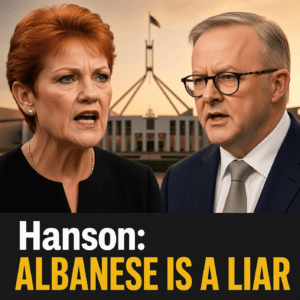
PAULINE HANSON GOES ON THE ATTACK: “WHERE DID THE BILLIONS GO?” — ONE NATION DEMANDS A FULL AUDIT
Senator Pauline Hanson has reignited one of Australia’s most divisive political debates, turning the spotlight on billions of dollars in public spending directed towards Indigenous programs and organisations.
In a fiery parliamentary intervention, the One Nation leader argued that Australians have been asked for decades to accept enormous levels of government expenditure in the name of “Closing the Gap” — yet many of the underlying problems remain stubbornly unresolved.
Her message was blunt: if governments have spent billions, taxpayers deserve to know exactly where the money went, who received it, and whether the programs actually worked.
“WHERE DID ALL THE MONEY GO?”
Hanson has been making this argument for years, but the issue has gained fresh attention as questions about Indigenous spending, corporate governance and Closing the Gap outcomes continue to surface.
In a 2024 Senate speech, Hanson claimed that hundreds of billions of taxpayer dollars had been spent over decades without sufficiently closing socioeconomic gaps. She also argued for a comprehensive audit of government expenditure.
Her central question is deceptively simple:
If enormous amounts of money have been allocated to improve Indigenous health, education, employment, housing and living conditions, why are so many communities still struggling?
That question is politically explosive because it goes directly to the credibility of Australia’s entire Closing the Gap framework.
And there is no doubt that significant public investment continues.
The federal government’s 2026–27 Budget, for example, includes $1.2 billion over five years for initiatives intended to improve outcomes for First Nations people, including employment, food security, family safety, education and health.
The previous 2025–26 Budget allocated another $1.3 billion over six years for initiatives aimed at improving outcomes for First Nations Australians.
For Hanson, however, the question is not simply how much money is being spent.
It is whether Australians are getting measurable results for that investment.
THE NUMBERS BEHIND THE ARGUMENT
The latest Closing the Gap data provide a complicated picture.
According to the Productivity Commission’s July 2026 assessment, some targets are improving and on track, while others are improving but still not on track. Several outcomes show no meaningful change, and some are actually worsening.
Employment is among the areas assessed as improving and on track.
But life expectancy, Year 12 attainment, tertiary qualifications, youth engagement and appropriately sized housing are among the areas improving without being on track to meet their targets.
Even more troubling, according to the Productivity Commission, outcomes are worsening in areas including children being developmentally on track, adult imprisonment, children in out-of-home care and suicide.
That doesn’t prove Hanson’s broader allegations about an “industry”.
But it does explain why the question of effectiveness and accountability remains politically powerful.
After decades of policies, strategies, programs and billions of dollars in expenditure, Australians are entitled to ask whether individual programs are delivering what governments promised.
THE CORPORATE MONEY TRAIL
And this is where the debate becomes even more interesting.
A major Australian National Audit Office report published in June 2026 examined the support and regulation of Indigenous corporations.
The audit found that Indigenous corporations collectively reported at least $4.5 billion in revenue in 2023–24.
There were 3,284 Indigenous corporations registered under the relevant legislation as of June 2025.
The organisations are far from insignificant: they hold billions of dollars in assets and income and employ tens of thousands of people.
But the audit also uncovered a serious compliance problem.
Only 29 per cent of Indigenous corporations were compliant with the deadline for lodging their 2024–25 annual reports.
That figure does not mean 71 per cent were corrupt.
It does not mean money was stolen.
And it certainly does not justify treating Indigenous organisations as a single homogeneous group.
But it does raise an important question about transparency.
How can taxpayers, members and regulators properly assess organisations managing substantial public and community resources when annual reporting requirements are not being met?
The ANAO found that between 2022–23 and 2024–25, ORIC received 1,067 reports of concern, completed 127 examinations, eight special administrations and 27 investigations.
Those numbers demonstrate that oversight already exists.
The question is whether that oversight is strong enough.
$1.9 BILLION IN GRANT FUNDING
One figure in the audit is particularly striking.
ORIC told the ANAO that Indigenous corporations had reported approximately $1.9 billion in grant funding for 2024–25 as of January 2026.
That represented around 54 per cent of total reported income among the corporations receiving grant funding.
Again, this does not mean $1.9 billion was wasted.
Government grants can fund essential services, employment, housing, health programs, community development and other legitimate activities.
But the figure demonstrates the enormous scale of the financial ecosystem surrounding Indigenous service delivery.
And that makes Hanson’s demand for stronger scrutiny politically difficult to dismiss entirely.
The real question should not simply be “Should Indigenous programs receive funding?”
It should be:
Which programs work? Which don’t? Who receives the money? What outcomes are achieved? And what happens when organisations fail to meet their obligations?
HANSON’S “ABORIGINAL INDUSTRY” CLAIM
Hanson uses the deliberately provocative phrase “Aboriginal industry” to describe what she regards as a network of organisations, activists, programs and bureaucracies that she believes has developed around Indigenous policy.
Her critics argue that this language unfairly lumps together legitimate Indigenous organisations and individuals who provide vital services to remote and disadvantaged communities.
That criticism deserves consideration.
The ANAO itself notes that Indigenous corporations play an important role in delivering services and supporting economic development, particularly in rural and remote Australia.
So an audit of spending should not automatically be interpreted as an attack on Indigenous communities.
In fact, the opposite argument can be made.
If taxpayers are serious about improving outcomes for disadvantaged Australians, then waste, weak governance and ineffective programs should be identified regardless of who receives the funding.
The money should follow results.
THE “GRAVY TRAIN” QUESTION
Hanson has repeatedly described the system as a “gravy train” and demanded a forensic examination of public spending.
In 2025, One Nation renewed that demand after highlighting reports that 1,258 Indigenous corporations had failed to lodge required reports for the 2023–24 financial year. That figure came from ORIC reporting and was used by Hanson to argue for a comprehensive audit.
But there is an important distinction.
Failure to lodge a report is a compliance failure, not automatically evidence of fraud or corruption.
That distinction matters.
A responsible investigation would need to follow the money, examine contracts, evaluate outcomes, identify conflicts of interest and determine whether public funds were spent according to their intended purpose.
Anything less risks replacing evidence with political rhetoric.
THE CLOSING THE GAP DILEMMA
The biggest challenge for governments is that the data do not fit neatly into either political narrative.
It would be misleading to claim that nothing has improved.
The Productivity Commission says preschool enrolment has met its target, while employment is improving and on track.
At the same time, it would be equally misleading to pretend that the Closing the Gap project has solved the problem.
It hasn’t.
Several major targets remain off track, while some indicators have deteriorated.
That leaves Australia facing a difficult question that cannot be answered simply by announcing another funding package.
What actually works?
If one program produces measurable improvements, why not expand it?
If another program repeatedly fails, why continue funding it?
And if an organisation receives millions of dollars but cannot demonstrate meaningful outcomes or meet basic reporting requirements, shouldn’t taxpayers demand answers?
Those are reasonable accountability questions.
HANSON’S EQUALITY ARGUMENT
Underlying the entire Hanson campaign is her long-standing political philosophy that government assistance should be based on individual need rather than race.
She has repeatedly used the phrase:
“Equal rights for all and special rights for none.”
That position has been central to One Nation’s Indigenous policy for years.
Her critics argue that race-based programs can sometimes be necessary because Indigenous Australians experience specific historical, geographic and socioeconomic disadvantages.
The government similarly argues that working with First Nations communities and organisations can improve service delivery and outcomes.
The debate therefore isn’t simply about money.
It is about how Australia defines equality.
Should equality mean identical treatment regardless of circumstances?
Or should government sometimes provide targeted assistance to groups experiencing specific disadvantages?
That argument has been at the heart of Australian politics for decades.
THE BILLIONS QUESTION ISN’T GOING AWAY
It should be about results.
Hanson wants a comprehensive audit.
Her opponents fear that rhetoric about an “Aboriginal industry” risks demonising organisations and people who provide essential services.
Between those two positions lies a potentially productive question:
Can Australia demand absolute accountability for every taxpayer dollar while still ensuring that disadvantaged Indigenous Australians receive the services they need?
That is the debate Canberra cannot avoid forever.
Because after decades of promises, programs and billions in expenditure, Australians are increasingly asking the most uncomfortable question of all: