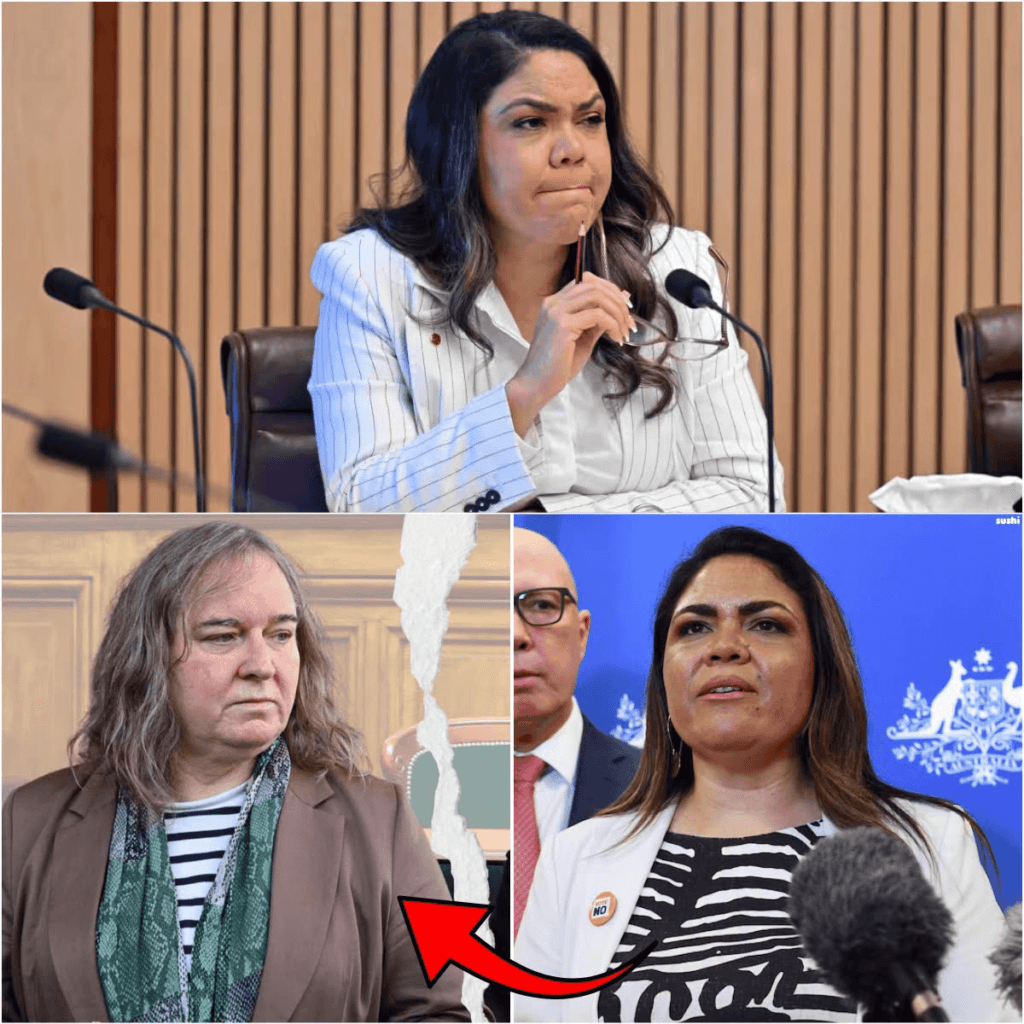
Australia’s fierce debate over sex, gender and women-only spaces has entered another dramatic chapter, with Senator Jacinta Nampijinpa Price publicly backing women’s rights campaigner Sall Grover after Grover’s long-running legal battle over her female-only social networking platform.
Price’s support for Grover was highlighted during her appearance at CPAC Australia 2025 in Brisbane, where she spoke forcefully about the importance of protecting women’s rights and challenged what she sees as growing pressure on women to accept changing definitions of sex and gender.
The issue has since become even more significant. In May 2026, the Full Federal Court upheld the finding that Grover and her company, Giggle for Girls, had unlawfully discriminated against transgender woman Roxanne Tickle. The court found that Tickle’s exclusion from the women-only app amounted to direct discrimination based on gender identity.
And now, in the latest development, the High Court of Australia has refused Grover and Giggle permission to appeal, effectively bringing the litigation to an end at Australia’s highest court. The High Court’s disposition records the matter as Giggle for Girls Pty Ltd & Anor v Tickle, decided on September 10, 2026.
A LEGAL FIGHT THAT STARTED WITH A WOMEN-ONLY APP
At the centre of the controversy is Giggle for Girls, a platform created by Sall Grover and marketed as a women-only social networking space. The app was designed around the idea that women should have a dedicated environment where they could communicate, seek support and build connections without men being present.
According to evidence recorded in the original Federal Court proceedings, users were asked to upload a photograph during registration. The platform used third-party artificial-intelligence software intended to distinguish facial appearances associated with men and women. Roxanne Tickle, a transgender woman, was initially accepted by the system but was later removed from the platform.
That decision eventually became the centre of a landmark discrimination case. Grover argued that her decision concerned biological sex and the purpose of creating a women-only environment. Tickle argued that she had been excluded because she was transgender. The courts ultimately accepted Tickle’s position.
THE FEDERAL COURT RULING
In August 2024, the Federal Court found that Grover had contravened Australia’s Sex Discrimination Act. The case was already highly controversial at that point because it raised a question far larger than the future of one social-media platform: Can a service designed specifically for women lawfully exclude a transgender woman on the basis of biological sex?
The Full Federal Court later considered the appeal. In May 2026, the appeal court upheld the discrimination finding and went further in characterising the conduct as direct discrimination. Grover and Giggle were ordered to pay A$20,000 in damages, with potentially substantial legal costs. The Federal Court itself established a dedicated online file for the appeal because of the significant public interest surrounding the proceedings.
PRICE’S SUPPORT FOR GROVER
Against that legal backdrop, Jacinta Nampijinpa Price’s earlier appearance at CPAC Australia took on renewed significance. Price has become one of Australia’s most prominent conservative voices on questions involving sex, women’s rights, culture and identity. Her public support for Grover placed her firmly on one side of an increasingly bitter national argument.
For supporters of Grover, the case is not simply about an app. They argue that women should retain the ability to establish spaces based on biological sex when privacy, safety or female solidarity are involved. Critics take the opposite view, arguing that transgender women are women under Australian law and that excluding them because of their transgender status can constitute unlawful discrimination. That fundamental disagreement is what has made the case so politically explosive.
“SAFE SPACES” HAVE BECOME A POLITICAL FLASHPOINT
The phrase “female safe spaces” has become one of the most politically charged expressions in Australia’s culture-war debate. Supporters of sex-based spaces argue that women have legitimate reasons for wanting environments where biological sex matters. They point to settings involving intimate privacy, vulnerability, sexual violence, domestic violence support and women’s advocacy. Opponents warn that broad exclusion based on transgender status can undermine the legal protections provided to transgender Australians.
The courts have now made an important statement about how Australia’s discrimination law applies to this particular dispute. But the political argument is far from settled.
GROVER REFUSED TO BACK DOWN
Throughout the case, Grover maintained her position. She has argued that the purpose of Giggle was to create a space specifically for women and that changing its membership rules would undermine the reason the platform existed in the first place. The Federal Court’s published materials show just how deeply Grover viewed the dispute as connected to the identity and purpose of her business.
For her supporters, that persistence has transformed Grover into a symbol of resistance. For her critics, however, the case demonstrates why Australia’s discrimination protections need to apply regardless of gender identity. The legal system has ultimately sided with Tickle.
THE HIGH COURT’S FINAL DECISION
The latest development is arguably the most significant. On September 10, 2026, the High Court refused special leave in the Giggle for Girls case. That means the High Court will not hear Grover’s proposed further appeal. The decision leaves the Federal Court’s appeal judgment standing. In practical terms, Grover has now exhausted the ordinary avenue of appeal in Australia’s highest court. That makes the case one of the most consequential Australian legal battles over gender identity and discrimination to reach the courts.
BUT THE POLITICAL FIGHT MAY JUST BE BEGINNING
A court ruling does not necessarily end a political controversy. In fact, cases involving sex and gender have repeatedly moved from courtrooms into parliaments, election campaigns and public demonstrations. Politicians including conservative lawmakers have questioned whether Australia’s existing discrimination framework strikes the right balance between protections based on gender identity and the ability to establish sex-specific services.
Grover’s supporters are likely to continue campaigning for legislative change. Those who supported Tickle, meanwhile, are likely to regard the High Court’s refusal as confirmation that transgender Australians remain protected by existing discrimination law. The debate therefore moves beyond the question of what happened to one person on one app. It becomes a question about what Australian law should permit in the future.
WHY JACINTA PRICE’S POSITION MATTERS
Price’s intervention is particularly significant because she has a substantial political following and has repeatedly positioned herself as a defender of women’s interests. Her views on gender and women’s rights have also become part of her broader political identity. In 2025, she spoke publicly about wanting to build a feminist movement focused on Indigenous women, emphasising gender equality and women’s rights. Her support for Grover therefore fits into a broader political argument Price has made about the importance of protecting women. It also places her directly in one of Australia’s most divisive cultural debates.
A CASE WITH CONSEQUENCES BEYOND GIGGLE
The significance of the case extends beyond Giggle for Girls. The Federal Court’s proceedings examined how provisions of the Sex Discrimination Act 1984 apply when a service provider attempts to distinguish between biological sex and gender identity. That interpretation could influence how businesses, community organisations and other service providers think about sex-specific spaces. At the same time, advocates for transgender Australians argue that weakening existing protections could expose transgender people to discrimination in other areas of everyday life. The legal question is therefore closely connected to a much wider social question: Where should the law draw the line?
AUSTRALIA’S CULTURE WAR IS FAR FROM OVER
The Grover case arrives at a time when debates about gender identity are becoming increasingly prominent across Australian politics. Questions about women’s sport, prisons, healthcare, changing rooms, schools, workplaces and single-sex services have all generated intense public discussion. Political parties have increasingly found themselves under pressure to define their positions. For conservatives, the case provides another example of what they see as the erosion of biological-sex-based distinctions. For progressive groups, it demonstrates the importance of ensuring that transgender Australians are protected from exclusion and discrimination. Neither side appears ready to retreat.
THE HUMAN STORY BEHIND THE LEGAL ARGUMENT
Yet beneath the political slogans are two very different human experiences. Tickle pursued the case after being denied continued access to a platform she believed should have been available to her as a woman. Grover fought the case because she believed that her decision to create a female-only platform was legitimate and protected by principles of sex-based equality. Both sides have described the dispute as fundamentally connected to dignity, identity and safety. That is one reason the case has attracted such intense attention. It is not merely an argument about an app’s terms and conditions. It touches questions that many Australians regard as deeply personal.
WHAT HAPPENS NEXT?
The legal chapter has effectively closed with the High Court’s refusal to hear the appeal. But the political chapter is unlikely to end there. Sall Grover has continued to speak publicly about the case and the broader debate over sex and gender. Jacinta Nampijinpa Price remains a prominent political voice advocating a more traditional understanding of sex-based rights. Meanwhile, transgender-rights advocates are likely to defend the existing legal framework and the protections it provides.
The disagreement between those positions is unlikely to disappear because of a court judgment. If anything, the ruling could intensify calls for Parliament to revisit the legislation itself. And that is where the next battle may take place. The courts have now drawn one legal line. But will Australia’s politicians decide that line should remain — or move it?