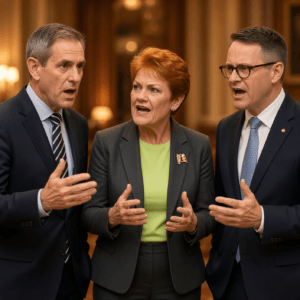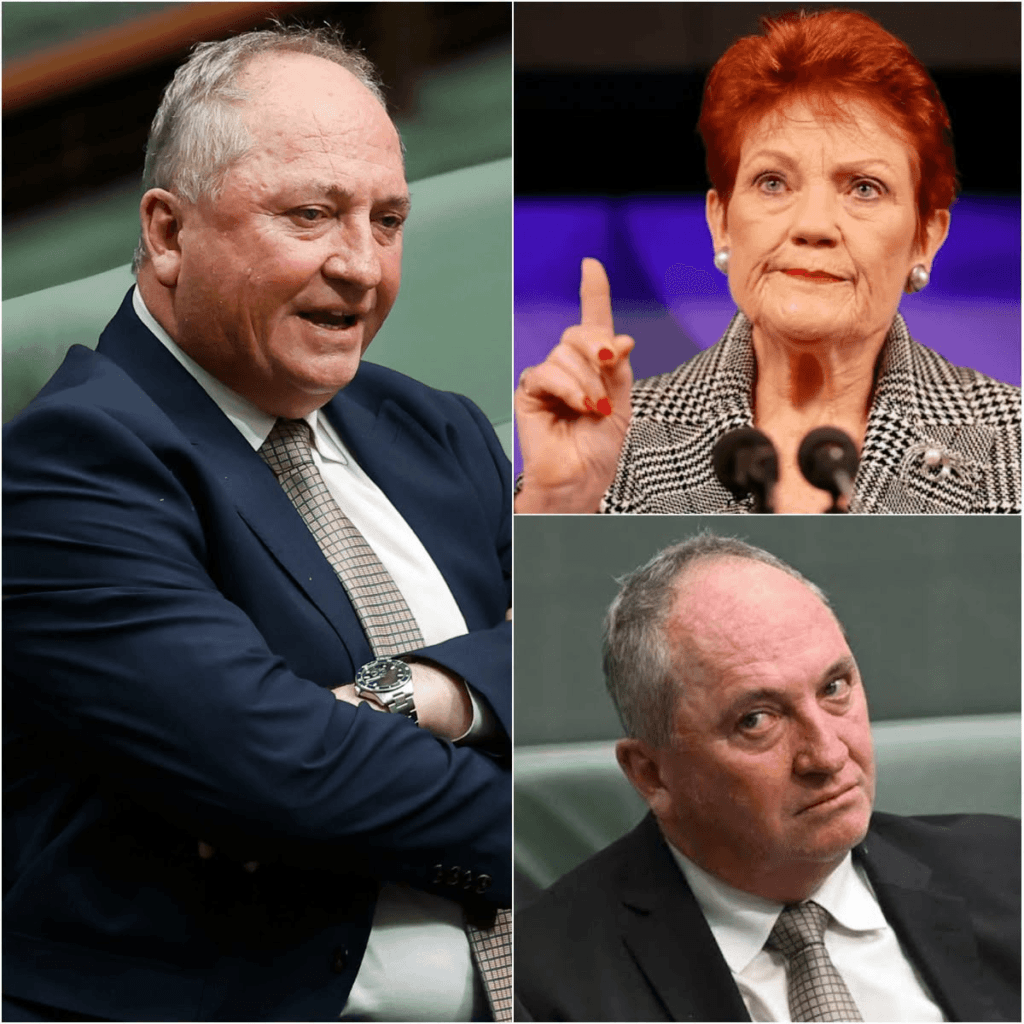
Canberra’s political landscape has been undergoing a noticeable realignment, and one of the most significant developments has been the decision by former Nationals leader and deputy prime minister Barnaby Joyce to join Pauline Hanson’s One Nation. Rather than being a single dramatic parliamentary moment, the move has created a new political alignment that has attracted attention across the major parties.
Joyce’s move matters because he is not a newcomer to federal politics. He previously led the Nationals and served as deputy prime minister, giving him an established profile inside conservative Australian politics. His decision to move across to One Nation therefore represented a significant change in political alignment rather than simply another parliamentary switch.
For Hanson, the development created another high-profile figure alongside her as One Nation sought to expand its presence and political reach.
The shift also changed the way One Nation was discussed in Canberra. Hanson had already spent years building the party around issues including immigration, national identity, energy policy and opposition to parts of the mainstream political establishment.
Joyce brought a different political history to that platform.
His background in the Nationals means he has experience inside a major conservative party and in government. His move therefore gave One Nation access to a politician with first-hand experience of cabinet, government administration and coalition politics.
That does not automatically translate into greater parliamentary power.
But it does change the political conversation surrounding the party.
Joyce himself has described widespread frustration among Australians with the direction of the country. In May 2026, he told the Guardian that there was an “overwhelming” sense of frustration among people who believed Australia lacked a clear vision for the future.
That message fits closely with the political argument Hanson has developed over decades.
The difference is that Joyce previously delivered similar concerns from within the Nationals.
Now he is delivering them alongside Hanson.
That distinction has become increasingly important as One Nation’s support has expanded during 2026. Recent polling has placed the party in a much stronger position than in previous federal contests, although polling measurements remain snapshots of opinion rather than election results or guarantees of future outcomes.
The rise has also forced other political parties to respond.
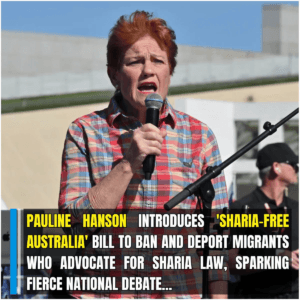
Hanson has openly discussed working with the Liberals and Nationals on some parliamentary objectives while ruling out a formal coalition arrangement. In March 2026, she said One Nation wanted to work with the Coalition, including on preferences, while rejecting an official power-sharing partnership.
That position creates an unusual political dynamic.
One Nation can remain outside the traditional Coalition structure while still attempting to influence the broader conservative political space.
Joyce’s presence makes that dynamic even more visible.
His move does not mean One Nation and the Coalition have become the same political force. In fact, important differences remain over policy, political strategy and how conservative politics should be organized.
Those differences have occasionally become public.
Immigration is one example.
Hanson has pushed for major reductions in migration and has made immigration one of One Nation’s defining political issues. Joyce has supported aspects of her position while also attempting to distinguish One Nation from historical interpretations of the White Australia policy. In July 2026, he said One Nation did not support bringing that policy back, while defending Hanson’s position on mass deportations of people overstaying visas.
That episode demonstrated both the strength and complexity of the Joyce-Hanson alliance.
Joyce can reinforce Hanson’s political message while simultaneously attempting to define where One Nation stands on controversial questions.
Energy policy has also become another major area of political competition.
One Nation has increasingly challenged Labor’s climate and energy strategy, while the Coalition has its own positions on gas, electricity reliability and emissions policy.
The competition therefore isn’t simply between Labor and One Nation.
There is also an ongoing contest over who represents voters dissatisfied with the major parties and how those concerns should translate into policy.
This is part of the broader fragmentation of Australian politics.
Traditional party loyalties have become less predictable, while minor parties and independents can exert greater influence in particular debates. The emergence of One Nation as a larger political force has added another layer to that changing landscape.
Media coverage has amplified the shift.
Every public appearance involving Hanson and Joyce now attracts attention not only because of what they say individually, but because of what their partnership might mean for the broader conservative political field.
Their visibility has increased further through controversies surrounding One Nation’s policies and public statements.
For example, Joyce has repeatedly been called upon to defend or explain Hanson’s comments and political positions. In July, he publicly defended her after controversy surrounding remarks about immigration and the White Australia policy, while also acknowledging differences in how those issues were interpreted.
That places Joyce in a distinctive position.
He is no longer simply a former Nationals leader commenting from outside One Nation.
He is now part of the political organization whose leader he is sometimes defending.
That creates opportunities, but also additional scrutiny.
Every disagreement involving Hanson can potentially become a question about Joyce’s own political judgment and the direction he has chosen.
The same applies in reverse.
Joyce’s statements can influence how voters and commentators interpret One Nation, particularly because of his previous senior positions within government.
But institutional recognition or additional parliamentary visibility should not be confused with automatic control over government policy.
Political influence depends on votes, parliamentary numbers, negotiations, public support and the ability to translate political messaging into concrete legislative outcomes.
That distinction is important when assessing the significance of the current shift.
The political landscape is clearly changing.
But exactly where that change leads remains uncertain.
One Nation’s stronger polling position has already prompted discussion about how Labor, the Coalition and other parties should respond. Some commentators have described the development as a major challenge to the traditional political order, while others have emphasized the uncertainty surrounding the party’s longer-term electoral trajectory.
The presence of Joyce adds another variable.
His political experience gives him knowledge of the Coalition from the inside, while his current role gives One Nation another prominent voice in national debates.
Whether that produces lasting institutional influence will depend on what happens next — including parliamentary negotiations, policy development, public reactions and future electoral contests.
For Hanson, meanwhile, the immediate effect is clear in one limited sense: her party now includes a politician who previously occupied one of the most senior positions in Australian conservative politics.
That alone has changed the optics surrounding One Nation.
It has also ensured that the party’s policies and strategy will receive even greater scrutiny.
And there is another side to the story.
The closer One Nation moves toward the centre of national political debate, the more detailed questions it faces about policy consistency, parliamentary conduct, funding, relationships and practical implementation.
Recent reporting has already examined questions surrounding One Nation’s relationships with major donors and the use of parliamentary travel and hospitality arrangements. Those matters are separate from Joyce’s decision to join the party, but they illustrate the level of scrutiny that accompanies its increased visibility.
So the real story is not simply that Barnaby Joyce made an unexpected move.
It is that a politician with decades of experience inside the Coalition has chosen to operate from within One Nation at a time when the party has become a much more prominent part of Australia’s political conversation.
That creates a new configuration in Canberra.
Hanson brings the established One Nation brand.
Joyce brings experience from the Nationals and government.
Together, they are operating in a political environment where traditional party boundaries are becoming less rigid and where voters are increasingly exposed to competing messages from Labor, the Coalition, One Nation and independents.
Whether this becomes a lasting transformation or another stage in Australia’s constantly shifting political landscape remains to be seen.
For now, however, Joyce’s move has ensured that Pauline Hanson’s political project is being discussed through a much wider lens.
And in Canberra, where seemingly small changes in political alignment can alter negotiations, alliances and parliamentary strategy, that is a development difficult to ignore.