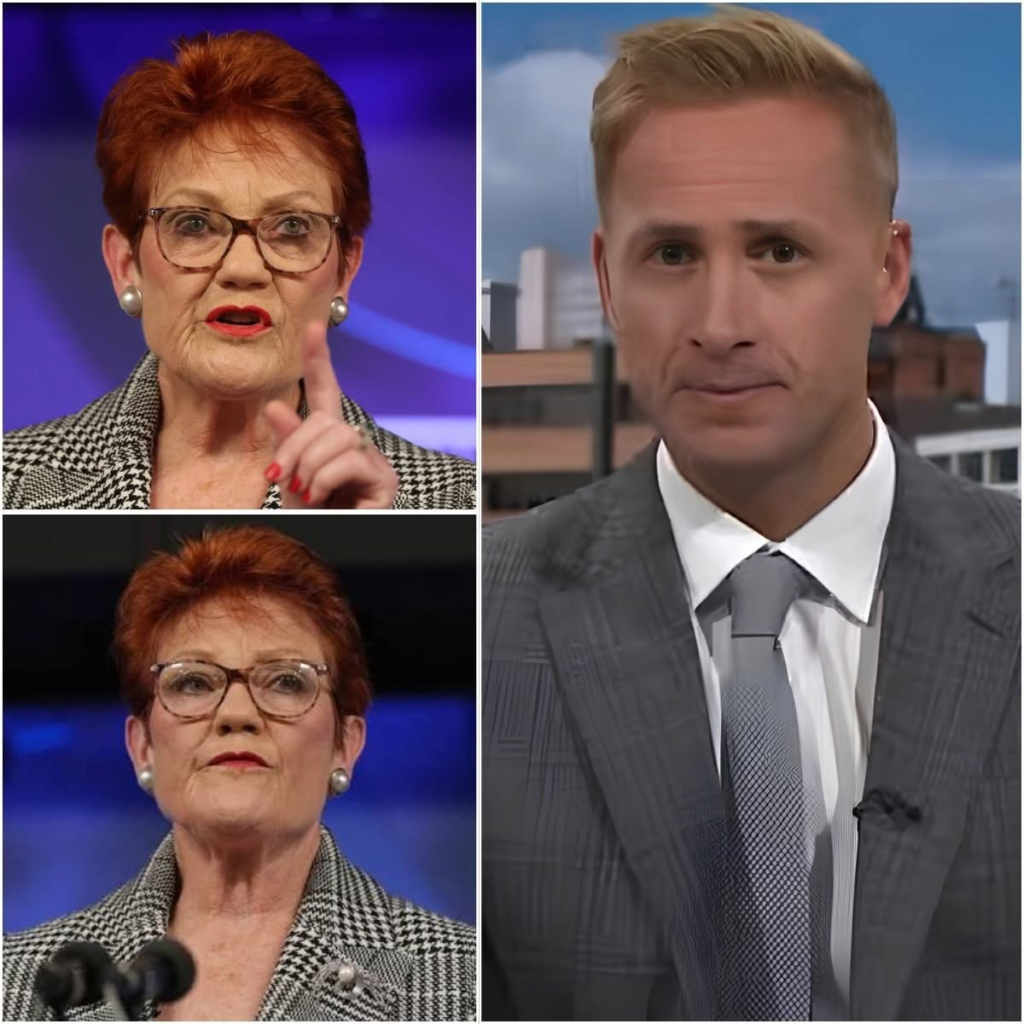
A sensational claim involving Pauline Hanson, former Q+A host Hamish Macdonald and an alleged $50 million defamation lawsuit has exploded across social media — but the story circulating online is not what it appears to be.
Posts making the rounds claim Hanson launched a massive legal battle after an explosive confrontation on television, allegedly accusing the ABC program and its host of defamation and demanding A$50 million in damages.

The language used in the posts is dramatic. Hanson is allegedly portrayed as declaring that she had been “defamed on live television” and warning that those responsible would “pay the price.”
The supposed lawsuit has been presented as a major confrontation between a controversial political figure and the national broadcaster — a legal showdown that, if real, could have attracted enormous attention across Australian politics and media.
But there is a serious problem with the story.

There is no credible evidence that Hanson filed the alleged A$50 million action against ABC or Q+A over such an incident.
AAP FactCheck investigated the claim and found no evidence that the alleged broadcast confrontation occurred, no evidence of the supposed lawsuit and no court records supporting the claim that Hanson was seeking A$50 million in damages.
The investigation also found that images accompanying the viral story showed signs of AI generation. The supposed television studio did not match the actual Q+A set, providing another warning sign that the dramatic scene circulating online may have been manufactured rather than documented.
That detail is crucial because the viral narrative is built around the appearance of authenticity.
It does not simply make a vague political accusation. It provides a specific television program, a recognizable host, a precise financial figure and supposedly explosive quotations.
Those details make the story sound like a genuine breaking-news report.
But specificity does not make a claim true.
In fact, fabricated political stories often rely on exactly this formula: a famous politician, a dramatic confrontation, a huge legal claim and quotations supposedly taken directly from the person involved.
The Hanson story fits that pattern remarkably closely.
There is, however, a real history between Pauline Hanson and Hamish Macdonald, which may help explain why the fabricated narrative appears believable to some readers.
Macdonald did previously interview Hanson in connection with Q+A and other ABC programming. In 2019, for example, Hanson appeared on ABC radio and was questioned by Macdonald about controversial comments concerning domestic violence orders and allegations made in family-law disputes. The exchange was real and was reported at the time.
Hanson’s political career has also repeatedly placed her in confrontational media environments.
As leader of One Nation, she has built a political profile around controversial positions on immigration, national identity, government policy and other highly divisive issues. Her public statements have frequently attracted intense criticism as well as strong support.
That history makes a supposed clash between Hanson and a journalist like Macdonald sound plausible to audiences already familiar with their previous interviews.
But plausibility is not evidence.
And this is where the alleged A$50 million lawsuit becomes particularly important.
A defamation claim of that magnitude would be an extraordinarily serious legal development. It would normally generate a substantial paper trail, particularly if proceedings had actually been commenced in court.
Yet AAP FactCheck found no evidence of the supposed legal action.
There is also another major problem with the viral story: Q+A itself is no longer operating in the form described by the posts.
AAP reported that the ABC discontinued Q+A in 2025. That makes any claim describing a recent Hanson-versus-Macdonald Q+A confrontation especially questionable.
The timeline therefore matters.
A story describing a supposedly recent live confrontation on Q+A, followed by an enormous lawsuit, would need to explain when the program aired and where the alleged broadcast can be found.
The viral posts do not provide convincing evidence of either.
No verified broadcast footage has emerged to substantiate the dramatic exchange described in the posts.
No credible Australian news organisation has reported the supposed A$50 million action.
And no court record has been identified supporting the claim.
That does not mean Hanson has never been involved in defamation proceedings.
In fact, her history demonstrates why legal claims involving her can sound believable.
Hanson has previously taken legal action against the ABC. In the late 1990s, she pursued a defamation matter involving ABC material, demonstrating that disputes between Hanson and the broadcaster have occurred in the past.
There have also been genuine defamation proceedings involving Hanson herself.
For example, former senator Brian Burston brought a Federal Court defamation case concerning statements published and made by Hanson in 2019.
Those genuine legal disputes create a real historical background against which fabricated stories can be constructed.
A reader who knows that Hanson has previously been involved in defamation litigation may therefore be more likely to believe a new claim involving a massive lawsuit.
But the existence of previous legal battles does not validate a new allegation.
The alleged A$50 million action must be judged on its own evidence.
And at present, the evidence does not support it.
That distinction is especially important in the modern political media environment.
Social media allows an invented confrontation to spread faster than a genuine court case can be reported.
A fabricated quotation can be placed inside quotation marks.
An AI-generated photograph can make two people appear to be sitting opposite each other in a television studio.
A dramatic headline can create the impression that something happened “today.”
Then the story is shared repeatedly until familiarity begins to look like confirmation.
This is one reason the alleged Hanson story attracted attention.
It contains all the ingredients of a viral political confrontation: television, politics, accusations, money, lawyers and a supposedly furious response.
The $50 million figure is particularly effective as a click-driving element because it immediately raises the stakes.
A reader seeing “$50 MILLION LAWSUIT” is naturally going to wonder what could possibly have happened to trigger such an extraordinary claim.
But without evidence, the number is simply part of the allegation.
The actual political and media debate surrounding Hanson is real enough without inventing a courtroom battle.
Her appearances on ABC programs have previously generated controversy, including a 2020 Q+A episode in which her comments prompted strong criticism from other panellists. ABC reported that Hanson faced criticism during the program, while the discussion also covered cancel culture, coronavirus restrictions and political disagreement.
That real history demonstrates something important.
Australian political television has produced genuinely heated exchanges involving Hanson.
There is therefore no need to manufacture one.
The real debates surrounding her views can already generate enormous disagreement.
The same applies to Hamish Macdonald.
Macdonald has spent years interviewing politicians and challenging controversial claims in political and current-affairs programs. His interviews have sometimes produced sharp exchanges, particularly when guests were asked to defend contentious statements.
But a difficult interview is not automatically defamation.
A tough question is not automatically a character attack.
And political disagreement is not automatically grounds for a multimillion-dollar lawsuit.
Defamation law in Australia involves specific legal questions about publication, meaning, harm and available defences. A person cannot simply declare that an interview was hostile and automatically obtain tens of millions of dollars.
That is precisely why claims about massive lawsuits require evidence.
The viral Hanson story skips over that crucial legal reality and moves directly from an alleged confrontation to an enormous damages figure.
That leap is one of the clearest reasons for caution.
The wider lesson is even more significant.
Political misinformation does not always rely on completely invented people or completely impossible events.
Sometimes it takes real politicians, real journalists, real past controversies and real historical disputes — then combines them into an event that never happened.
The result can be far more convincing than an obviously fake story.
AAP FactCheck has described a broader pattern of fabricated stories targeting Australian political figures, including false claims about lawsuits against the ABC. The Hanson claim was identified as part of this wider pattern of sensational political misinformation.
For audiences, the safest response is therefore not simply to ask whether a story sounds believable.
The better question is: Where is the evidence?
Where is the broadcast?
Where is the court filing?
Where is the official statement?
Where is the independent reporting?
And most importantly, where is the original source?
In this case, those questions lead to a very different conclusion from the sensational headline.
There is a real history of political conflict involving Pauline Hanson and ABC journalists.
There are real examples of heated interviews.
There are real defamation cases involving Hanson.
But there is currently no reliable evidence supporting the dramatic claim that Hanson launched a A$50 million lawsuit against Hamish Macdonald and Q+A following the alleged confrontation described online.
The story may be designed to provoke anger, curiosity and clicks.
And judging by how quickly it has circulated, it has achieved exactly that.
But the most explosive part of the story may not be the alleged lawsuit at all.
It may be how easily a completely unverified political confrontation can be made to look like breaking news.
For Pauline Hanson, Hamish Macdonald, the ABC and Australian audiences, that distinction matters.
Because when politics becomes increasingly polarised, the difference between a genuine controversy and a fabricated one can disappear remarkably quickly.
And once a false story has been shared thousands of times, correcting it can be far more difficult than creating it in the first place.
So before believing the headline screaming that Pauline Hanson is demanding A$50 million from ABC’s Q+A, there is one question worth asking:
Did the confrontation — and the lawsuit — actually happen?