“I’m Not Interested in Importing the World’s Problems”: Pauline Hanson Demands Immigration Ban
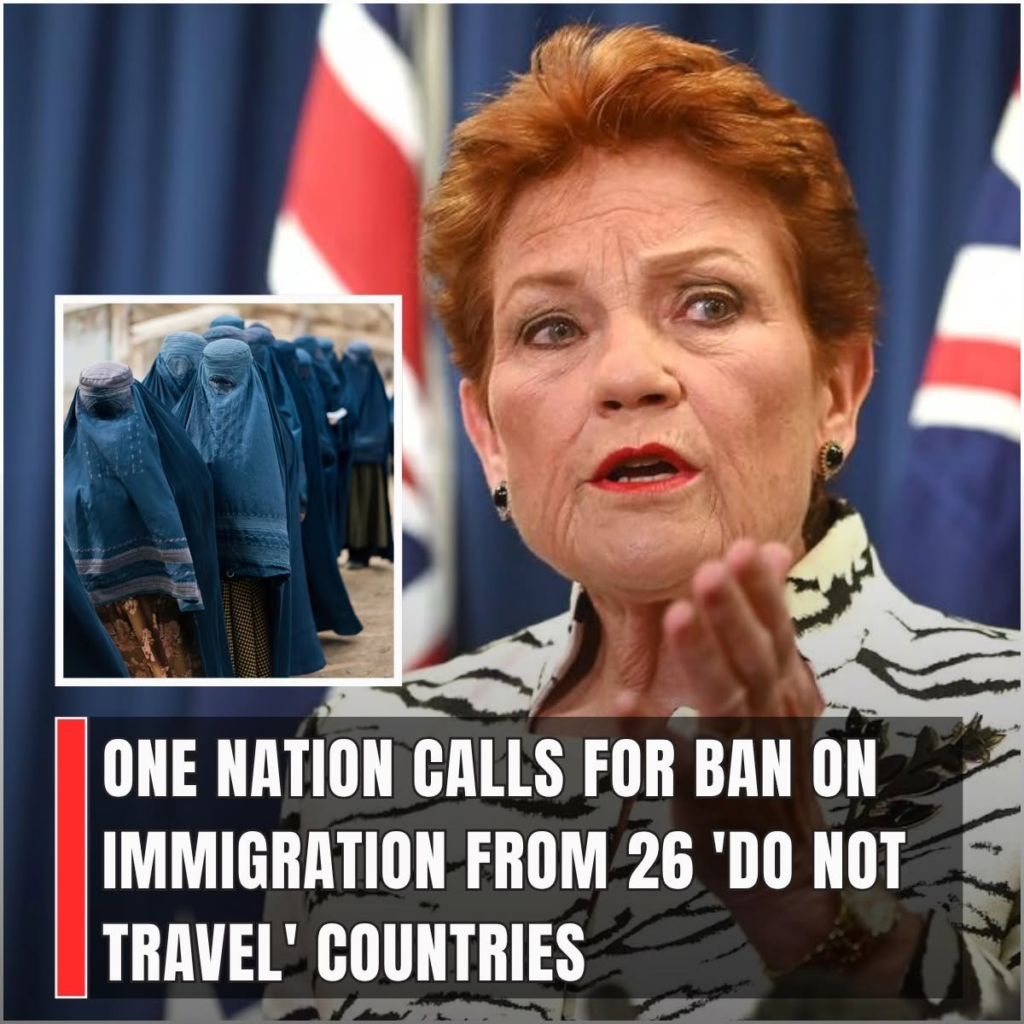
Australia’s immigration debate has just taken another dramatic turn. One Nation leader Pauline Hanson is calling for an immediate halt to migration from countries currently classified by the Australian government as “Do Not Travel” destinations — a proposal that could dramatically reshape the nation’s immigration and national security debate.
Hanson’s message is blunt: “I’m not interested in importing the world’s problems.”
Her proposal comes as Australia continues to grapple with concerns over migration levels, housing affordability, pressure on infrastructure and growing anxiety about national security. Hanson argues that there is a contradiction at the heart of current policy: if the Australian government tells its own citizens that certain countries are too dangerous to visit, why should Australia continue accepting migrants from those same places under normal visa arrangements?
That question has now become the centre of a rapidly escalating political fight.

The argument behind Hanson’s proposal
One Nation says Australia should immediately stop granting new offshore visas to people from countries subject to the government’s highest-level travel warnings. Reports have described the proposal as covering more than 20 countries and locations, with the exact number changing as Australia’s official travel advice is updated.
The distinction matters. Australia’s Department of Foreign Affairs and Trade regularly updates the Smartraveller system according to security conditions overseas. At Level 4, “Do Not Travel”, the government says travellers face extreme risks that can include terrorism, armed conflict, violent unrest, arbitrary detention and kidnapping.
The current list includes countries and territories such as Iran, Iraq, Lebanon, Palestine, Syria and Yemen, while other destinations have moved between warning levels as circumstances change. The official list also includes high-risk destinations outside the Middle East, including several countries in Africa, Europe and the Americas.
For Hanson, the logic is straightforward: if a country is considered too dangerous for Australians to visit, its nationals should face much stricter scrutiny when seeking to migrate to Australia.
But that argument raises a much bigger question: should a travel warning automatically influence a person’s eligibility to migrate?
A travel warning is not an immigration ban
This is where the debate becomes more complicated.
The Australian government’s “Do Not Travel” classification is designed primarily to protect Australians overseas. It assesses the security environment in a particular destination and warns Australians about the risks they may face there. It does not, by itself, establish that every person from that country represents a security threat.

Smartraveller explains that Level 4 destinations may be dangerous because of armed conflict, terrorism, violent social unrest, arbitrary detention, crime or other extreme risks.
In other words, the warning concerns conditions in a country, not automatically the character or intentions of every individual who comes from that country.
That distinction is likely to become one of the strongest arguments against Hanson’s proposal.
Critics can argue that a blanket restriction could prevent legitimate students, workers, family members and refugees from entering Australia simply because of their nationality. Supporters, however, are likely to counter that national security requires governments to act before risks become crises rather than after something goes wrong.
Iran provides a revealing example
Australia has already taken exceptional immigration measures in response to security concerns surrounding Iran.
In March 2026, the government introduced temporary restrictions affecting many Iranian passport holders outside Australia who held Visitor subclass 600 visas. Under the Arrival Control Determination, those visas temporarily ceased to be in effect unless an exemption applied. The measure was introduced amid the wider conflict and security crisis involving Iran.
That decision is significant because it demonstrates that Australia already possesses mechanisms to restrict entry in exceptional circumstances.
Hanson’s argument is essentially that these powers should be applied more broadly — and not only when a crisis reaches a particular country, but whenever the government itself classifies that destination as too dangerous for Australians to visit.
The government, however, has not accepted that logic as a general immigration principle.
Migration, housing and population pressure
Hanson’s proposal is also connected to a much wider argument about Australia’s population growth.
One Nation has repeatedly criticised the scale of migration, arguing that rapid population growth is placing pressure on housing, infrastructure and public services. Hanson has recently pushed for a substantially lower migration intake and has also criticised the role of international education in Australia’s migration system.
This issue has become politically potent because housing affordability remains a major concern for Australian voters.
The Coalition has also moved toward a lower migration target, although its approach is not identical to One Nation’s. Recent reporting says Opposition Leader Angus Taylor has proposed reducing net overseas migration to below 173,000, linking population growth more closely to Australia’s ability to build enough homes and infrastructure.
That means Hanson is not arguing in a political vacuum. Immigration is increasingly becoming a central battleground between the major parties and smaller political movements.
But the economic argument cuts both ways

There is another side to the debate.
Australia relies heavily on migration to fill skills shortages, support economic growth and sustain important industries. Business groups have warned that excessively sharp immigration cuts could make labour shortages worse, particularly in sectors already struggling to find qualified workers. Recent debate over migration levels has therefore focused not only on housing but also on the economic contribution of migrants.
International education is another major part of this discussion. Australia has built a substantial education export industry around international students, meaning significant restrictions could have consequences well beyond immigration numbers.
This creates a difficult political balancing act: how can Australia reduce pressure on housing and infrastructure while still attracting the workers, students and skills the economy needs?
Hanson’s proposal also touches the refugee debate
One of the most controversial elements is the potential effect on humanitarian and refugee pathways.
One Nation has said its proposed changes should apply to new offshore visas from countries on the relevant “Do Not Travel” list, including refugee and humanitarian visas.
That would transform the proposal from a conventional migration-control policy into a much broader debate about Australia’s humanitarian responsibilities.
Supporters could argue that security screening must come first, particularly when applicants come from regions affected by war, terrorism or state collapse.
Opponents could argue that people fleeing those very conditions may be among those most in need of protection.
That tension between security and humanitarian responsibility is likely to become one of the most difficult aspects of the debate.
A growing political fault line
Hanson’s immigration proposal arrives at a time when One Nation’s influence has been rising.
Recent polling has shown the party gaining substantial support, while Hanson has increasingly positioned herself at the centre of debates over immigration, national identity, security and multiculturalism.
Foreign Affairs Minister Penny Wong has strongly criticised Hanson’s vision of a “monocultural society”, arguing that multiculturalism is a strength rather than a weakness and warning that divisive politics can undermine social cohesion and national security.
The backlash has already moved beyond Parliament. Hundreds of students and supporters recently demonstrated against One Nation’s positions on migration and international students, accusing the party of using migrants as political scapegoats.
That reaction shows just how explosive this issue has become.

What happens next?
For now, Hanson’s proposal is a political demand, not a blanket immigration ban already in force.
The real question is whether her argument will gain enough support to force the government and opposition parties to adopt tougher country-based migration restrictions.
Australia is now facing a debate that goes far beyond the number of migrants entering the country. It touches national security, housing, economic growth, humanitarian obligations, multiculturalism and the fundamental question of what Australia wants its immigration system to achieve.
Hanson has reduced the argument to one powerful line:
“I’m not interested in importing the world’s problems.”
Her critics will ask whether the problems belong to countries, governments and security situations — or whether Australia risks unfairly treating millions of individuals as though they are responsible for the conditions of the countries they come from.
That is the question likely to define the next stage of Australia’s immigration debate.