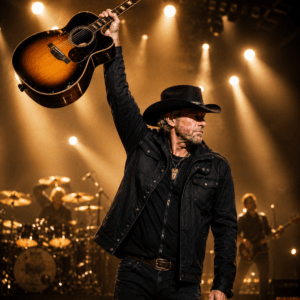
Two days before everything changed, Eric Church stood under the lights and looked out at a sea of smiling faces.
Fans sang along.
Hands filled the air.
People traveled from across the country to be there.
It felt like countless other festival weekends that country music fans had shared for years.
No one knew what was coming.
Forty-eight hours later, the Route 91 Harvest Festival in Las Vegas became the site of one of the darkest nights in country music history.
For Eric Church, the tragedy became something he would carry long after the headlines faded.
The Fan Who Never Made It Home
Among those who lost their lives was Sonny Melton.
He was 29 years old.
Friends and family later remembered him as a devoted husband and a kind-hearted man who loved country music.
When the shooting began, Sonny reportedly used his own body to shield his wife, Heather.
She survived.
He did not.
The story spread quickly through the country music community.
For many, Sonny became a symbol of courage in the middle of unimaginable chaos.
Eric Church’s Connection To The Tragedy
What made the loss even harder for Eric Church was how close he had been to the event.
Just two nights earlier, he had performed on that same stage.
He had jumped into the crowd.
Shaken hands.
Taken photographs.
Shared moments with fans who were simply there to enjoy a weekend of music.
After the tragedy, those memories became difficult to process.
The places he remembered as joyful gathering spots suddenly carried entirely different meaning.
Sleep became difficult.
Thoughts became impossible to quiet.
The grief felt personal.

The Song He Had To Write
Artists often process pain through music.
For Eric Church, that process led to a song called “Why Not Me.”
It wasn’t built around radio success.
It wasn’t designed to become a commercial hit.
Instead, it became a way to confront a question that many people struggle with after tragedy.
Why did some people survive while others did not?
The song reflected grief, confusion, and compassion.
Not answers.
Just honest emotion.
The Night At The Grand Ole Opry
When Church performed the song at the Grand Ole Opry, the atmosphere felt different from an ordinary concert.
His voice carried the weight of recent events.
The room listened in silence.
Every word seemed heavier than usual.
Every pause lingered longer.
This wasn’t entertainment.
It was mourning set to music.
And many in attendance understood that immediately.
The Empty Chairs
During the performance, two seats remained empty.
One represented Sonny Melton.
The other represented Heather.
Those chairs became a powerful reminder of the lives forever changed by the tragedy.
They symbolized absence.
Loss.
And the countless stories interrupted far too soon.
For those in the audience, the image was impossible to ignore.
A Song That Became A Tribute
Over time, “Why Not Me” became more than a song connected to a single event.
It became a tribute to resilience, remembrance, and the people whose lives left lasting impact on those around them.
For Eric Church, writing it did not erase the pain.
It did not answer every question.
But it allowed him to honor the people who should have been able to go home that night.
Years later, the song remains one of the most personal recordings of his career.
Not because of chart positions or awards.
But because it came from a place of genuine heartbreak.
And because behind every lyric was a face, a family, and a memory that country music promised never to forget.