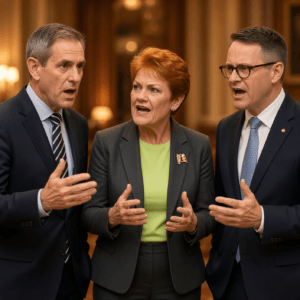
Three One Nation senators have turned their backs during the Acknowledgement of Country as federal Parliament returned to Canberra, reviving one of the party’s most provocative protests over Indigenous ceremonies and Australian national identity.
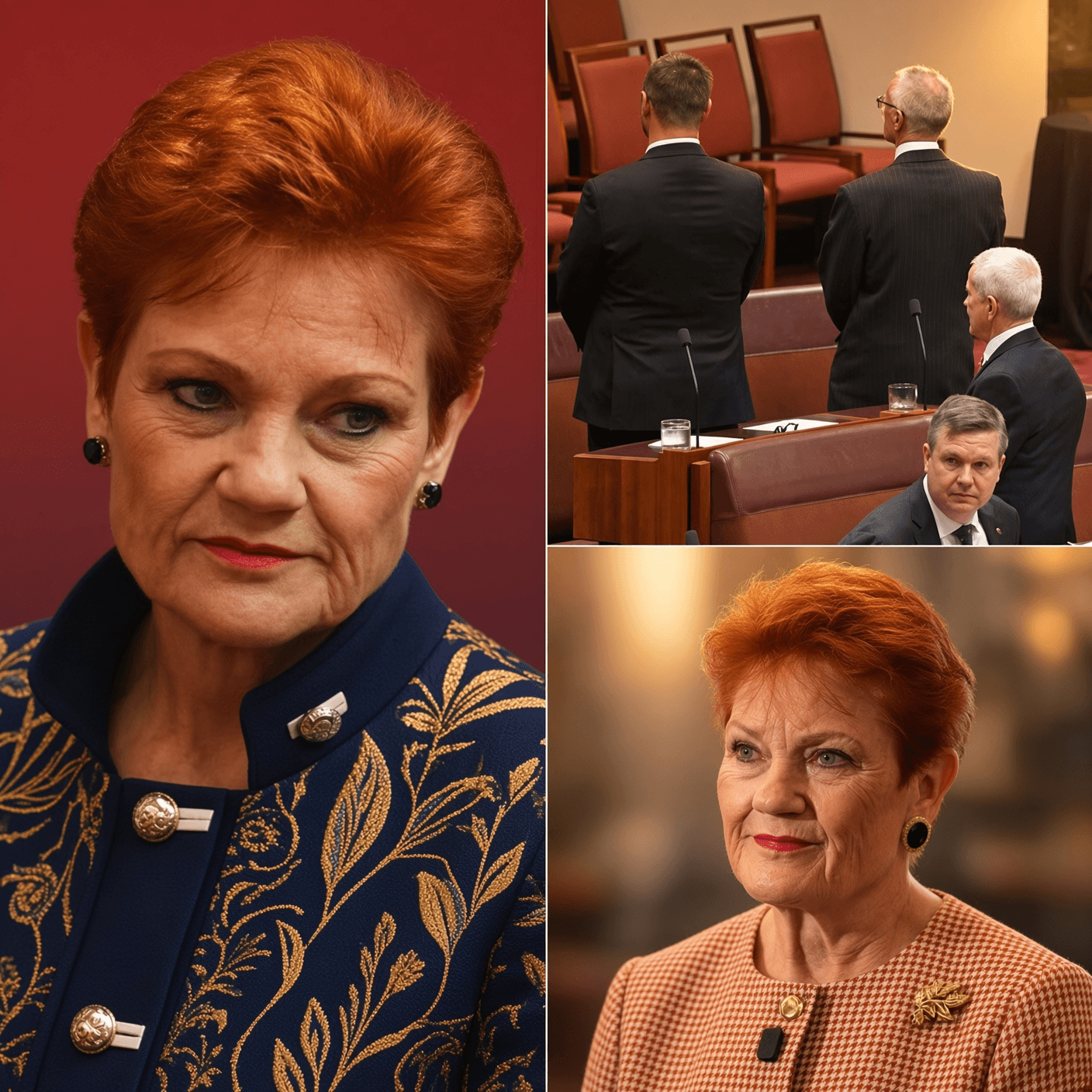
Queensland Senator Malcolm Roberts, New South Wales Senator Sean Bell and Western Australian Senator Tyron Whitten stood facing away as Deputy Senate President Slade Brockman delivered the customary Acknowledgement of Country in the Senate chamber on Tuesday.
The three senators then turned back around as proceedings moved to the parliamentary prayer.
One Nation leader Pauline Hanson, the party’s fourth senator, was not in the chamber during the protest.
There was no accompanying speech from the three senators as the Acknowledgement was delivered. The act itself was the message — a continuation of One Nation’s increasingly explicit campaign against official Acknowledgement of Country and Welcome to Country practices.
The demonstration came as Hanson pushes the issue beyond symbolic parliamentary protest and towards formal One Nation policy, saying she would remove such practices from government departments and schools if she became prime minister.
It also closely repeated an action taken by One Nation senators at the opening of the new Parliament last year, which triggered a fierce confrontation in the Senate over whether the protest represented legitimate political dissent or deliberate disrespect towards Indigenous Australians.
What happened in the Senate
The latest protest occurred during the formal opening proceedings of the Senate’s sitting day.
Roberts, Bell and Whitten remained standing but physically turned away from Brockman while he delivered the Acknowledgement of Country.
Once it was finished, the senators faced forward again for the prayer.
Hanson was absent during that part of proceedings, although she later entered the chamber and sought to suspend standing orders for an unrelated motion concerning the government’s handling of women who had returned to Australia after travelling to Islamic State-controlled territory.
The contrast between the senators’ response to the two parliamentary rituals was unmistakable.
They turned away for the Acknowledgement of Country and turned back for the prayer.
That distinction is consistent with One Nation’s publicly stated position rather than appearing to have been an accidental or spontaneous gesture.
Acknowledgement is part of Senate procedure
The Acknowledgement of Country is not an informal addition made by individual senators.
It forms part of the Senate’s standing orders governing the beginning of a sitting day.
Under Standing Order 50, the presiding officer acknowledges the Ngunnawal and Ngambri peoples as the traditional custodians of the Canberra area and pays respect to the elders, past and present, of Australia’s Indigenous peoples.
The parliamentary prayer follows.
The Acknowledgement was incorporated into Senate procedure in 2010 and has since become an established part of the chamber’s opening routine.
That does not require individual senators to agree with it politically.
Nor are senators required to enter the chamber specifically to participate in the Acknowledgement.
That point became central to the argument after One Nation staged similar protests in 2025.
Critics argued that deliberately entering or remaining in the chamber and turning away transformed non-participation into a calculated political demonstration.
One Nation says that is precisely the point: its senators want their opposition to the practice to be visible.
One Nation has done it before
The sight of One Nation senators turning their backs is not new.
At the opening of the 48th Parliament in July 2025, the party’s senators also turned away during an Acknowledgement of Country.
The protest drew an angry response from Indigenous Australians Minister Malarndirri McCarthy, who later addressed the Senate.
McCarthy described the conduct as a “childish” and “hurtful” stunt and accused One Nation senators of making a deliberate decision to disrespect First Nations Australians.
She pointed out that senators did not have to be present for the Acknowledgement if they objected to participating.
McCarthy argued that choosing to attend and then visibly turn away was therefore an active political statement rather than simply declining to take part.
Speaking separately about the controversy, she said senators represented millions of Australians, including First Nations people, and described the behaviour as unacceptable, rude and disrespectful.
Hanson rejected that interpretation.
She said the protest represented Australians who voted against establishing an Indigenous Voice to Parliament in the 2023 referendum and who she believed were increasingly frustrated by repeated Indigenous acknowledgements and ceremonies.
“They don’t want this division that is happening in our country,” Hanson said at the time.
She argued that One Nation’s protest was intended to oppose division rather than create it.
Hanson wants the ceremonies removed
Since then, Hanson has made clear that One Nation’s objection is not limited to the Senate.
During a recent television appearance in which she outlined what she would do in government, Hanson was asked whether she would remove Welcome to Country practices from schools.
Her answer was emphatic.
Hanson said private businesses would remain free to hold ceremonies if they wished, but a government she led would remove them from government departments and the education system.
She also objected to acknowledgements appearing on official government material and websites.
“I wouldn’t be having it in schools or the education system. I’d shut that all down,” Hanson said.
She then broadened the argument to official flags.
“And I’ll tell you another thing too, there won’t be three flags.”
The remark reflected another One Nation campaign: giving the Australian National Flag primacy over the Aboriginal and Torres Strait Islander flags at government institutions.
Together, the positions amount to a broader policy on national symbolism rather than an isolated objection to a few ceremonial words in Parliament.
Welcome and Acknowledgement are not the same thing
The political debate frequently uses “Welcome to Country” and “Acknowledgement of Country” interchangeably, but they are different practices.
A Welcome to Country is generally delivered by a Traditional Owner or authorised Indigenous representative with cultural connections to the country on which an event takes place.
An Acknowledgement of Country can be delivered by Indigenous or non-Indigenous people and acknowledges the Traditional Owners of the land and pays respect to Aboriginal and Torres Strait Islander peoples.
The ritual performed in the Senate each sitting day is an Acknowledgement of Country, not a Welcome to Country.
The distinction matters because Hanson’s policy opposition encompasses both practices, while the latest Senate protest specifically targeted the Acknowledgement embedded in parliamentary procedure.
McCarthy called earlier protests ‘childish’
The strongest parliamentary response to One Nation’s previous demonstrations came from McCarthy.
In her 2025 Senate intervention, she argued that One Nation senators had deliberately chosen a confrontational form of protest.
She questioned whether the motivation was attention, social-media engagement or an attempt to provoke offence.
Her broader argument was that political disagreements about Indigenous policy could be debated without rejecting a parliamentary gesture of respect towards First Nations people.
Labor Senate leader Penny Wong similarly argued that senators did not have to agree with the tradition but should respect it as part of the rituals of the chamber.
The Greens were more forceful, accusing Hanson and One Nation of contributing to racial division.
But opposition to Acknowledgements has not been confined entirely to One Nation.
Coalition senator Jacinta Nampijinpa Price, a Warlpiri-Celtic woman, criticised One Nation’s manner of protest in 2025 while also saying she did not support routine Acknowledgements of Country.
Price argued Australians should be treated equally and described some Indigenous symbolism as political virtue signalling.
That distinction illustrated the wider debate: politicians can oppose the proliferation of Acknowledgements while disagreeing sharply over whether turning one’s back in Parliament is an appropriate way to demonstrate it.
Hanson says Australians have ‘had a gutful’
Hanson has argued that her position reflects a broader shift in public attitudes following the defeat of the Indigenous Voice referendum.
The proposed constitutional amendment was rejected nationally in October 2023, with 60.06 per cent voting No and 39.94 per cent voting Yes.
One Nation interprets that result as support for its argument that governments should move away from policies and symbols that distinguish Australians according to Indigenous status.
That interpretation goes further than the referendum question itself.
The Voice referendum asked voters whether the Constitution should be altered to recognise Aboriginal and Torres Strait Islander peoples by establishing an advisory body called the Aboriginal and Torres Strait Islander Voice.
It did not ask voters whether they supported Welcome to Country ceremonies, Acknowledgements of Country or Indigenous flags.
Nevertheless, Hanson has repeatedly invoked the result as political evidence that many Australians share her frustration with the prominence of those practices.
She says Australians are tired of being made to feel like outsiders in their own country and regards repeated acknowledgements as divisive rather than unifying.
The argument over ‘division’
That word — division — sits at the centre of both sides’ arguments.
One Nation says repeatedly distinguishing Indigenous Australians from other Australians divides the country.
Its preferred model places a single Australian national identity above racial or ancestral distinctions.
Supporters of Acknowledgements make almost the opposite argument.
They say recognising that Aboriginal and Torres Strait Islander peoples lived on the continent for tens of thousands of years before European settlement does not diminish the Australian identity of anyone else.
For them, an Acknowledgement is a short gesture of historical recognition and respect, not a statement that non-Indigenous Australians do not belong.
That disagreement explains why a ceremony lasting only seconds has become such a persistent front in Australia’s culture wars.
The dispute is not fundamentally about the length of the statement.
It is about competing ideas of what national unity requires.
One Nation is making the protest part of its identity
Tuesday’s action suggests One Nation has no intention of quietly abandoning the issue as Parliament turns to economic, security and cost-of-living debates.
The protest required no legislation and no lengthy speech.
Three senators simply turned around.
But because the action occurred inside the Senate at the formal beginning of a sitting day, its political message was immediately recognisable.
It also reinforces Hanson’s recent attempt to translate longstanding culture-war positions into a more concrete program for government.
Her proposals now include removing government and school Acknowledgements, changing the display of official flags and reshaping Commonwealth policy towards Indigenous-specific institutions.
Whether those positions broaden One Nation’s appeal or deepen opposition to the party remains a political question.
What is already clear is that the party believes opposition to institutional Indigenous ceremonies is an electoral asset rather than a liability.
What happens next
The senators’ action does not itself alter Senate procedure.
The Acknowledgement of Country remains part of the chamber’s formal opening under the standing orders and will continue unless the Senate votes to change those rules.
That is an important difference between protest and policy.
One Nation senators can turn their backs on the Acknowledgement, leave the chamber or publicly campaign against it.
Removing it from Senate procedure would require parliamentary action.
Likewise, Hanson’s promise to eliminate acknowledgements across schools and government would depend on the legal authority of the Commonwealth over the institutions concerned, with state and territory governments retaining substantial responsibility for education and their own public sectors.
For now, the most immediate consequence is political.
One Nation has once again transformed the opening moments of a parliamentary sitting into a confrontation over national identity.
Its senators’ position could hardly have been made more visually explicit: they stood for the proceedings, turned their backs for the Acknowledgement of Country, then faced forward again when it was time for prayer.
There was no need for a speech.
The argument was already familiar.
And with Hanson now promising to turn that protest into government policy, the dispute over Acknowledgement of Country is likely to follow Parliament well beyond Tuesday morning.