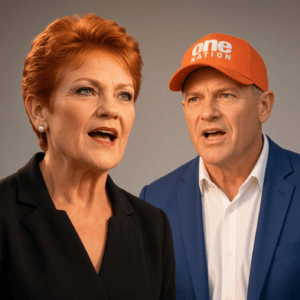
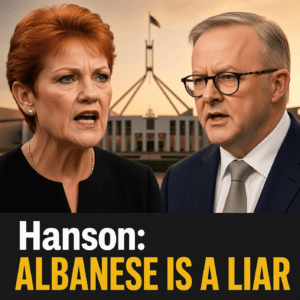
Pauline Hanson has intensified her campaign to restrict the burqa and other full-face Islamic coverings for new migrants, with her position gaining new attention after a senior figure from Australia’s intelligence and security community reportedly backed tougher immigration screening on national-security and integration grounds.
The One Nation leader has returned from a controversial tour of Britain more determined than ever to argue that Australia should prevent what she sees as the social and demographic changes experienced in parts of the United Kingdom.
Her trip included a highly contentious meeting with British anti-immigration activist Tommy Robinson and a walk through Luton, north-west of London, where a substantial Muslim population lives.
Hanson said what she witnessed strengthened her resolve to stop Australia following the same path.
She has repeatedly linked the burqa to questions of assimilation, women’s equality, security and the supremacy of Australian law, arguing that people seeking to make Australia their home should accept a common set of national values.
Her opponents reject that connection, warning that religious clothing cannot reasonably be treated as evidence that an individual supports extremism or rejects Australian society.
The latest intervention has therefore reopened a debate Australia has confronted repeatedly for almost two decades: how far a liberal democracy can go in requiring cultural integration without turning legitimate security concerns into discrimination against an entire religious community.
An intelligence insider enters the debate
The most significant new element is support reportedly expressed by an unnamed senior figure within Australia’s intelligence and security community.
According to reporting by Sky News and News24 journalist Sharri Markson, the figure argued that immigration should be restricted for families in which women are required to wear full-face coverings.
The reasoning reportedly extended beyond the practical problem of facial identification.
The security figure was said to view compulsory full-face covering as a potential indicator of broader attitudes towards women, social integration and values incompatible with Australia’s democratic and legal system.
That intervention gives Hanson’s long-running campaign a degree of support from outside One Nation.
But its significance requires an important qualification.
The individual has not been publicly identified, and the comments are not an official statement from ASIO, the Australian Federal Police, the Department of Home Affairs or the Australian government.
Nor does one anonymous senior figure establish that Australia’s intelligence community collectively supports a burqa ban.
The available evidence supports a narrower conclusion: at least one senior person from the security and intelligence establishment has privately advanced an argument that overlaps substantially with Hanson’s position.
That is politically noteworthy without turning it into an institutional endorsement.
Hanson returns from Britain determined to ‘fight it’
Hanson’s position hardened during a weeks-long trip through Britain and Europe that she characterised as a fact-finding mission.
The most controversial portion involved Robinson, whose real name is Stephen Yaxley-Lennon.
Robinson is a prominent British far-right and anti-Islam activist with an extensive criminal record, including convictions relating to assault, fraud and contempt of court.
Hanson appeared on his podcast and was filmed walking with him through Luton.
She later defended the meeting emphatically, rejecting suggestions that speaking to Robinson amounted to endorsing every aspect of his politics.
Her stated argument was that she wanted to hear directly from people about what had happened in Britain and draw lessons for Australia.
During the trip, Hanson said she had seen what Australia could eventually become if current immigration and multicultural policies continued.
She also used appearances in Britain to renew her attack on the burqa.
At the Conservative Political Action Conference in London, Hanson criticised Australia for failing to adopt a prohibition despite bans or restrictions on face coverings operating in numerous other countries.
She told the audience Australia had become too hesitant to defend its own cultural norms and linked the issue with broader concerns about mass migration and assimilation.
Hanson has also made clear that her immigration argument is increasingly focused on countries rather than simply overall numbers.
She has said she does not want migrants from certain countries associated with the wearing of the burqa and has separately advocated restrictions involving what she calls radical Islamic countries.
Not a new fight
The burqa has been one of Hanson’s signature political issues for years.
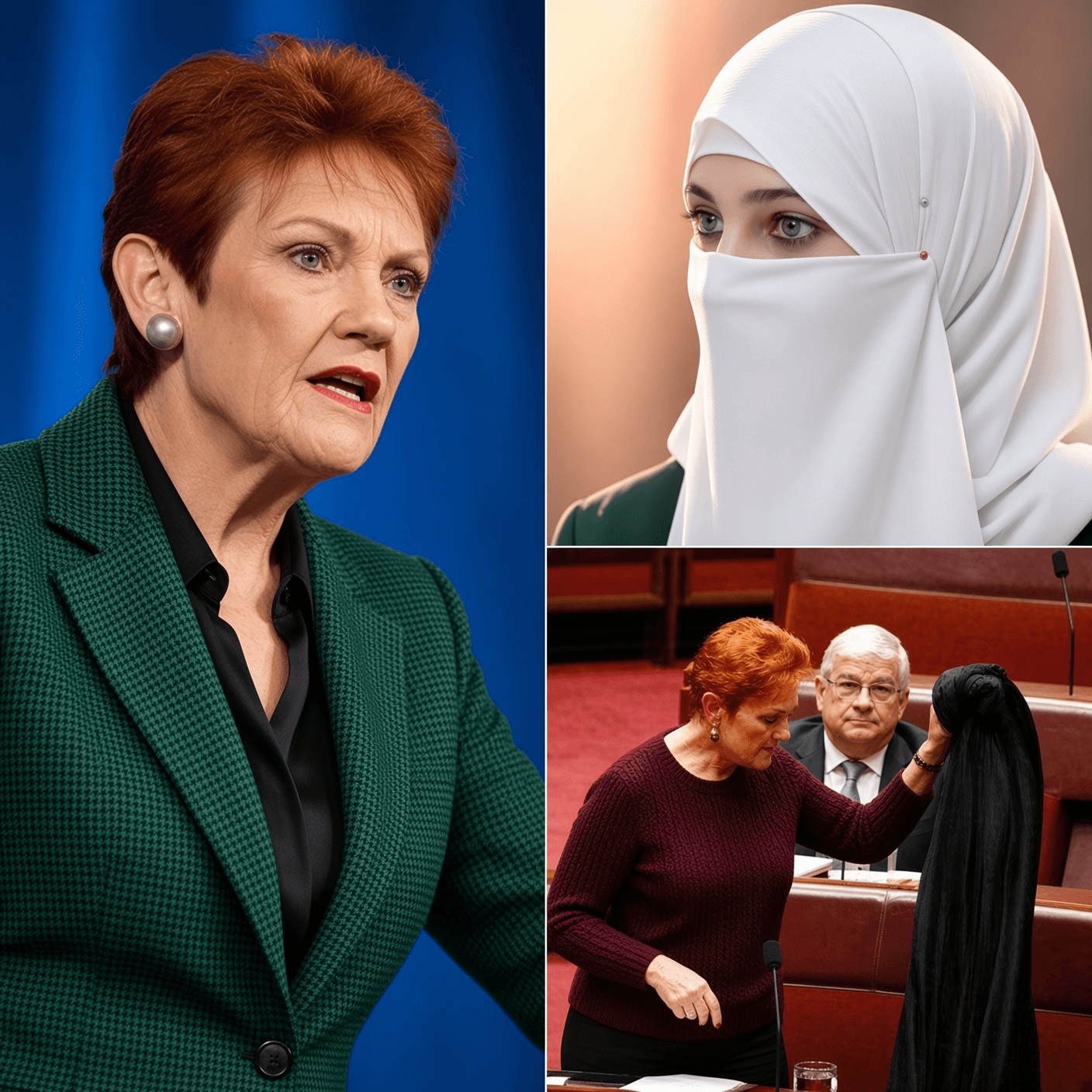
In 2017, she entered the Senate chamber wearing one as part of an attempt to draw attention to her proposed ban on full-face coverings.
Then attorney-general George Brandis, a senior Liberal minister, delivered an unusually forceful rebuke and warned Hanson that vilifying Australia’s Muslim community could undermine cooperation with law-enforcement and intelligence agencies.
Hanson revived the stunt in late 2025 after the Senate refused to allow her proposed bill on full-face coverings to proceed.
She was subsequently censured by the Senate.
The episode demonstrated that the issue remains just as divisive as it was eight years earlier.
Hanson argues the face must remain visible in a modern democratic society for reasons of identification, communication and security.
She also describes the burqa as a symbol of women’s oppression rather than a religious requirement deserving unrestricted protection.
Critics respond that adult women may choose to wear a niqab or other covering themselves, and that the state should be cautious about claiming to liberate women by dictating their clothing.
Australia does not currently have a nationwide ban
Australia has no general national prohibition preventing people from wearing a burqa or niqab in public.
There are circumstances where a person’s face can be required to be visible for identification, security, court procedures or other lawful purposes.
That is different from a blanket ban applying throughout public life.
Previous private members’ bills have sought to prohibit full-face coverings in Commonwealth places such as airports and other federally controlled locations, but those proposals have not produced the nationwide restriction Hanson wants.
That legal distinction goes to the centre of the current debate.
Requiring someone to reveal their face briefly when identity genuinely needs to be established is relatively narrow.
Prohibiting a religious garment throughout public spaces is substantially broader.
And using the garment as a criterion when deciding whether an entire family should be allowed to migrate to Australia goes further again.
Each measure therefore needs to be considered separately rather than bundled together under the single label of national security.
Security argument is more complicated than clothing
Australia unquestionably has a legitimate interest in preventing violent extremism.
Migration applicants can already be subjected to security, identity, health and character assessments.
The government can refuse or cancel visas in a range of circumstances involving security concerns or character issues.
Australian law also applies regardless of religion.
Forced marriage, domestic violence, child abuse and terrorism do not become lawful because someone claims a cultural or religious justification.
There is therefore no serious dispute that Australian law takes precedence when religious practices conflict with criminal or other enforceable law.
The more difficult question is whether clothing itself provides reliable information about an individual’s commitment to those laws.
A woman wearing a niqab may hold conservative religious beliefs.
That does not automatically establish that she supports terrorism, rejects democratic government, opposes women’s participation in public life or wishes to replace Australian law with religious law.
From a security perspective, relying too heavily on visible religious identity can also produce false positives while overlooking genuine extremists who display no distinctive clothing or outward religious markers.
That is why intelligence assessments traditionally focus on behaviour, associations, intentions and credible threat information rather than simply appearance.
The student who confronted Hanson
That distinction was illustrated dramatically when Hanson met Muslim students at an Islamic school in Brisbane during filming for Seven’s Spotlight.
One of those students, Nabiha, wears a niqab.
She later wrote about sitting across from Hanson and being conscious that the senator might see the face covering before seeing anything else about her.
Nabiha’s response was to describe the ordinary and ambitious life behind it.
She studies, prepares for exams and works with classmates.
She is passionate about robotics and has competed in robotics programs, including an international initiative involving girls working towards a satellite project.
Her argument was simple: the niqab says very little about her intellectual ambitions, citizenship or capacity to contribute.
She did not expect to convert Hanson to her view.
She wanted to be regarded as an individual before conclusions were drawn from what she wore.
That encounter provides an important real-world test for Hanson’s broader argument.
If full-face covering is treated automatically as evidence that a family is incompatible with Australian society, people such as Nabiha challenge the assumption that clothing can reliably answer that question.
The bigger argument is assimilation
For Hanson, however, the burqa is only one visible example of a much wider concern.
She has increasingly framed One Nation’s immigration policy around assimilation rather than race.
Hanson insists she does not support restoring the White Australia policy, despite controversially identifying its abolition as a turning point in Australia’s migration history during her discussion with Robinson.
She says her preferred model is a monocultural rather than multicultural Australia: people can come from different racial or national backgrounds but should share a common Australian civic culture.
Hanson has pointed to the Socceroos as an example of what she means — people of different ancestries operating under one flag, one law and a shared national identity.
Her critics say that apparently race-neutral formulation becomes more problematic when Hanson singles out Muslims, particular Muslim-majority countries or Islamic religious practices.
The difference between civic integration and religious exclusion therefore depends heavily on how any proposed policy is written and applied.
A rule requiring every migrant to obey Australian criminal law is universal.
A rule excluding applicants because they wear a particular religious garment is not.
Her UK comments went much further than the burqa
Hanson’s trip also attracted criticism because she made broader claims about Muslim migrants and welfare.
During her conversation with Robinson, she suggested migrants increasingly came to Australia for welfare and alleged that Muslims were prominently represented among people rorting the National Disability Insurance Scheme.
She did not provide evidence establishing those claims.
She also spoke approvingly about deporting people unlawfully in Australia and discussed the idea of “remigration” circulating among sections of the European right.
One Nation’s formal immigration policy calls for the removal of visa overstayers, unlawful non-residents and illegal workers.
Those proposals are distinct from removing lawful permanent residents or citizens on religious grounds.
Keeping those categories separate is essential if Australia is to have a rational immigration debate.
The major parties face a political dilemma
Labor, the Coalition and the Greens have all attacked aspects of Hanson’s rhetoric.
But simply condemning Hanson carries a political risk when One Nation is attracting substantially more support than it has through most of its history.
Voters concerned about immigration, housing and social cohesion may interpret moral condemnation without a substantive policy response as evidence that mainstream politicians refuse to engage with their concerns.
That does not mean major parties need to accept Hanson’s answers.
It means they need their own.
If a burqa ban would produce no measurable security benefit, opponents should explain why.
If identity requirements are already sufficient, governments should demonstrate how those rules work.
If cultural integration is a legitimate concern, politicians should define the behaviours and civic obligations expected of every migrant without applying collective suspicion according to religion.
And if immigration from particular places raises genuine security risks, those risks should be addressed through evidence-based security screening rather than assumptions about millions of people.
National security or cultural policy?
The most important question raised by the latest support from the unnamed intelligence figure may therefore be whether the burqa debate is truly about security.
Facial identification has a straightforward security dimension.
A woman’s freedom within her family has an equality dimension.
The willingness of migrants to obey Australian law has an integration dimension.
But none of those automatically produces the same policy response.
Australia can require a person to identify themselves without banning their clothing everywhere.
It can prosecute coercive control or forced marriage without assuming every visibly conservative Muslim family engages in it.
It can screen migrants for security risks without applying religious identity as a substitute for intelligence.
Hanson’s political strength comes partly from collapsing those issues into one powerful symbol: the covered face.
Her critics will need to do more than dismiss the symbolism if they want to persuade voters who believe it represents a wider failure of integration.
At the same time, Hanson’s responsibility is to demonstrate that the policies she proposes would target genuine problems rather than people whose appearance simply makes them politically easy to identify.
Her campaign has unquestionably moved beyond another parliamentary stunt.
One security insider has now publicly entered the argument through an anonymous briefing, Hanson has returned from Britain promising to fight harder, and One Nation’s growing electoral strength guarantees the issue will receive more attention.
The real test is whether Australia can distinguish three things that are increasingly being treated as one: national security, cultural integration and religious freedom.
A serious policy will have to deal with all three.