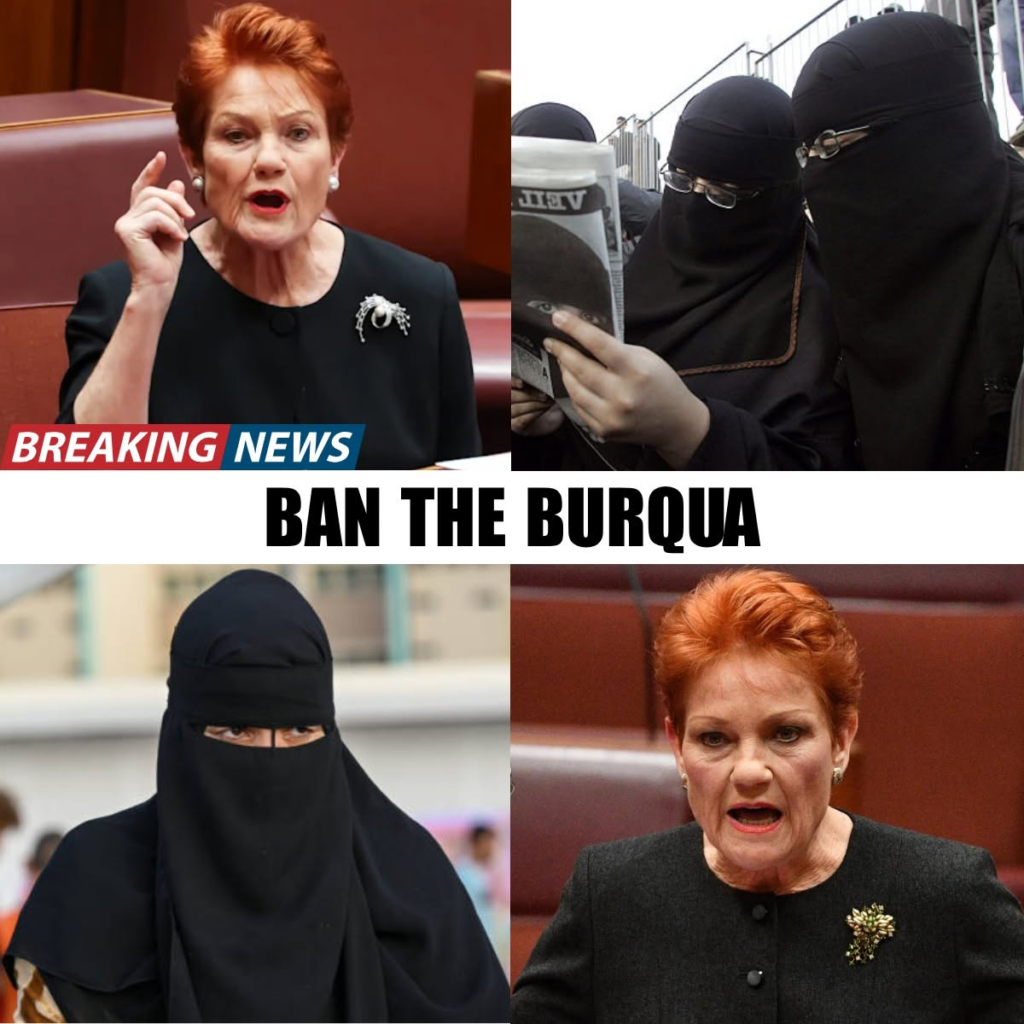
One Nation leader Pauline Hanson has renewed her call for a nationwide burqa ban, arguing that full-face Islamic coverings are incompatible with Australian culture. Her remarks have reignited a contentious debate over religious freedom, immigration, national identity and the limits of government power.
Hanson Renews Her Call for a Burqa Ban
Pauline Hanson has made her position clear: she wants Australia to prohibit the burqa, arguing that the full-face covering does not align with the country’s cultural values and way of life.
In a televised interview, the One Nation leader said she would not abandon her position, linking her proposed restriction to broader concerns about radical Islamist ideology, immigration policy and national security.
Hanson also suggested that Australia should consider restricting arrivals from certain countries if she believed their prevailing ideologies were incompatible with Australian society. However, the interview did not establish a specific list of countries or set out a detailed legislative proposal for implementing such restrictions.
Her remarks place religious dress and immigration controls back at the centre of Australia’s political debate, raising questions about how far the government should go in regulating religious expression in public life.
Religious Freedom and National Identity Collide
Hanson defended her position by arguing that Australia should maintain a common legal framework and protect what she described as its Judeo-Christian heritage.
During the interview, she questioned whether practices associated with particular interpretations of Islam were compatible with Australian values. She also expressed concern about extremist preachers and rhetoric that promotes hatred.
These statements reflect Hanson’s political position. They do not establish that Muslim Australians as a group support extremism or reject Australian law.
The distinction is important because Islam encompasses diverse communities, beliefs and practices. A debate about full-face coverings, religious freedom or security measures must distinguish between individual conduct and assumptions about an entire religious population.
Critics of a nationwide ban would likely focus on whether such a restriction unnecessarily limits freedom of religion, personal autonomy and equal treatment under the law. Supporters may argue that face-covering restrictions can be justified in particular circumstances, including identity verification or specific security requirements.
The precise legal implications would depend on the wording and scope of any legislation introduced.
Hanson Rejects Calls to Abandon Her Position
The interview also revisited controversy surrounding Hanson’s previous remarks about whether there are “good Muslims.”
Asked about the comments, Hanson argued that her earlier statement had been taken out of context and said she had been discussing radical Islam and the hypothetical situation of a call for jihad.
She maintained her broader concerns about extremism and pointed to developments in countries including Britain, Canada, Germany and France.
The exchange highlighted the tension between Hanson’s stated focus on extremist ideology and the broader wording of some of her comments about Muslims. Critics may argue that such language risks unfairly casting suspicion on people because of their religion, while her supporters may see it as an uncompromising approach to security and integration.
Hanson also responded to comments from a One Nation parliamentarian who spoke positively about his migrant friends and Muslim partner. She said that a person’s religion was not the central issue in that particular case, instead distinguishing ordinary individuals from religious leaders she accused of promoting hatred.
That response adds complexity to the debate over how Hanson defines the boundary between peaceful religious practice and the ideology she opposes.
Immigration and the Cost-of-Living Debate
Hanson’s call for a burqa ban came during a wider discussion about immigration, housing affordability and household expenses.
She argued that high migration levels were contributing to pressure on housing and public services. During the interview, she cited 739,000 people arriving in Australia in 2022–23 and claimed that only 51,650 were skilled workers.
Those figures require careful interpretation. Arrivals are not the same as net overseas migration, and the transcript does not provide enough supporting detail to verify her claim about the number of skilled workers.
Hanson also argued that the government should reduce migration while addressing the pressures faced by families struggling with housing and everyday expenses. She criticised energy costs, business regulations and government spending, while advocating greater reliance on coal-fired power and nuclear energy.
Her proposed policy direction extends beyond immigration. She called for a broader overhaul of Australia’s tax system, including changes to negative gearing, capital gains tax, tax-bracket indexation and income splitting for eligible families.
The interview therefore presented her burqa position as one part of a larger political argument about Australia’s economic direction, public services and national identity.
Could a National Burqa Ban Become Law?
A nationwide prohibition would require more than a political announcement. Any proposal would need a clearly defined scope, a legal basis and consideration of its interaction with existing laws and protections.
Questions would include whether the restriction applied in all public spaces or only in specified settings, how it would be enforced, and whether exemptions would apply for medical, safety or identity-verification purposes.
It would also be necessary to distinguish a ban on a particular garment from broader restrictions on Muslim immigration. These are separate policy proposals with different legal and practical implications.
The interview confirms Hanson’s support for banning the burqa, but it does not provide a complete bill text or demonstrate that a nationwide prohibition has been enacted.
A Debate That Extends Beyond One Garment

Hanson’s position has brought several difficult questions into focus: how Australia balances religious freedom with public policy, how immigration rules should be determined, and how political leaders can address extremism without unfairly targeting peaceful communities.
For One Nation, the burqa ban is part of a broader platform centred on national identity, immigration restrictions and opposition to what Hanson regards as incompatible cultural practices.
For critics, the central concern is whether such measures would impose disproportionate restrictions on religious expression or encourage discrimination.
The outcome of the debate will depend on the specific policies proposed, the evidence used to justify them and the legal safeguards surrounding their implementation. Until a formal legislative text is available, claims about the exact reach of a national ban should be treated cautiously.